
Stacking Cranes Market Outlook 2034
Jan 21, 2025Projected to Reach US$ 1.9 Billion, Driven by Growing Demand for Efficient Material Handling Solutions - Latest Report by TMR
The Stacking Cranes Market is driven by the increasing demand for efficient material handling solutions in logistics, warehousing, and manufacturing industries. The market's expansion is also fueled by advancements in automation technology and the growing adoption of smart storage systems to optimize operational efficiency and space utilization.
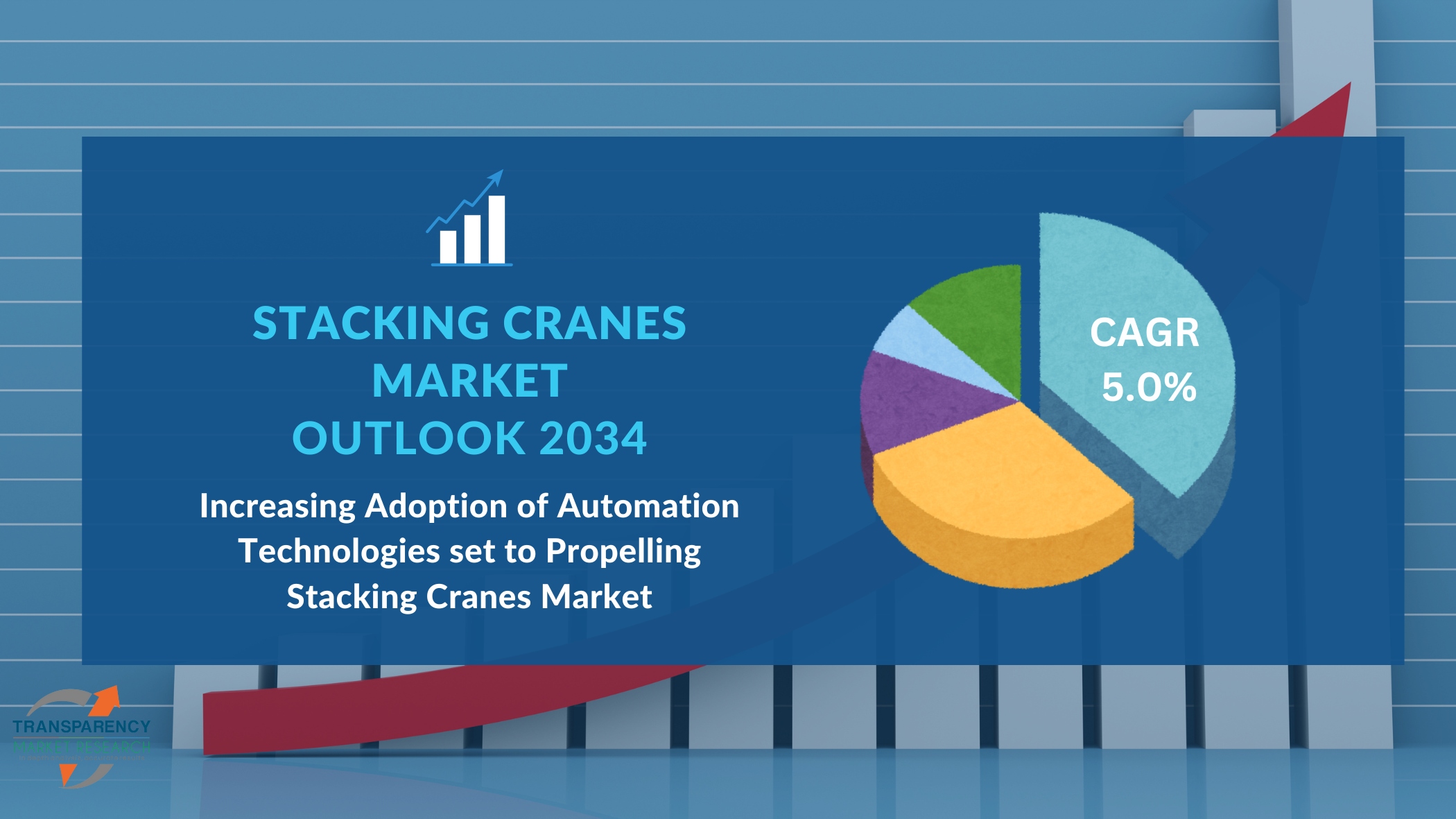
The Stacking Cranes Market, valued at US$ 1.1 Bn in 2023, is projected to witness steady growth over the coming years. Expanding at a CAGR of 5.0% from 2024 to 2034, the market is expected to reach US$ 1.9 Bn by 2034. This growth is driven by increasing adoption in logistics and warehousing to enhance operational efficiency.
Introduction:
The stacking cranes market (Markt für Stapelkräne) plays a critical role in the efficient handling and storage of goods in various industries, particularly in logistics, shipping, and warehousing. These cranes, designed to move and stack containers or heavy loads, have become an essential part of modern supply chain systems. With the rise in e-commerce, increased shipping activities, and the need for optimized storage solutions, stacking cranes have seen significant demand worldwide.
This report delves into the key drivers, major players, strategies, segmentation, opportunities, industry trends, and future prospects of the stacking cranes market. By providing insights into current market dynamics, we aim to give stakeholders a comprehensive overview of the market's potential for growth.
Get a Detailed PDF Brochure to Explore the Future of the Stacking Cranes Market - https://www.transparencymarketresearch.com/sample/sample.php?flag=S&rep_id=86412
Market Overview:
Stacking cranes, also known as automated storage and retrieval systems (ASRS) cranes, are used to efficiently stack, retrieve, and transport goods within high-bay warehouses and container yards. They play a vital role in automating processes, reducing labor costs, and improving operational efficiency in material handling.
The global stacking cranes market is witnessing strong growth due to the rising need for automation across industries such as logistics, warehousing, manufacturing, and retail. The increasing adoption of advanced technologies in logistics operations and the growing demand for efficient storage and transportation solutions are key factors propelling the market forward.
Key Players and Strategies:
The stacking cranes market report highlights prominent players, including Konecranes Plc., Liebherr Group, Demag Cranes & Components GmbH, Mecalux, Jungheinrich AG, Daifuku Co., Ltd., SSI Schaefer, Murata Machinery, Vanderlande Industries, Kardex Remstar, Toyota Material Handling, Hyster-Yale Materials Handling, Beumer Group, Stöcklin Logistics, Swisslog, among others.
Several key players dominate the stacking cranes market, each adopting different strategies to maintain competitiveness. These players focus on product innovation, mergers, and partnerships to strengthen their market presence.
- Konecranes: Known for its robust and efficient stacking cranes, Konecranes focuses on integrating cutting-edge technology such as IoT and AI for smart crane operations.
- Kalmar (Cargotec): Kalmar is a global leader in providing automation solutions for ports and terminals. The company’s stacking cranes are designed to maximize productivity and offer seamless integration with other material handling systems.
- Liebherr: Liebherr focuses on high-performance, reliable cranes that can handle heavy loads in tough environments. The company’s emphasis on customization and customer-centric solutions has helped it remain competitive.
- Sany Heavy Industry Co., Ltd.: Sany is a major player in the global market, offering cost-effective stacking crane solutions, primarily in the APAC region. The company aims to expand its market presence by catering to emerging markets and increasing its product portfolio.
Get Customized Market Analysis and Insights Designed for Your Business - https://www.transparencymarketresearch.com/sample/sample.php?flag=S&rep_id=86412
Key Growth Drivers:
- Rising E-commerce Industry: The exponential growth of e-commerce has led to a surge in the need for efficient storage and transportation of goods. Stacking cranes, with their ability to handle large volumes of goods and optimize space, are essential in ensuring smooth warehouse operations for e-commerce giants.
- Increased Automation in Logistics: With industries increasingly adopting automation to improve efficiency and reduce human errors, stacking cranes have become indispensable. Automated cranes reduce manual labor, increase precision, and help in better inventory management.
- Urbanization and Infrastructure Development: The rise in urbanization and the development of modern infrastructure, especially in developing economies, is driving the demand for advanced material handling systems. Ports, airports, and industrial facilities are increasingly relying on stacking cranes to optimize their operations.
- Focus on Cost Reduction and Operational Efficiency: Businesses are constantly seeking ways to reduce operational costs. Stacking cranes provide a cost-effective solution by reducing dependency on manual labor, minimizing operational errors, and enhancing productivity.
- Sustainability and Energy Efficiency: As industries are increasingly focusing on sustainability, modern stacking cranes are designed to be energy-efficient and environmentally friendly. These cranes reduce energy consumption and contribute to greener operations in warehouses and ports.
Opportunities:
- Emerging Markets: Developing countries are investing heavily in infrastructure development, providing significant opportunities for stacking crane manufacturers. Ports and airports in countries like India, China, and Brazil are expanding, leading to increased demand for advanced material handling solutions.
- Technological Advancements: With innovations like AI, IoT, and 5G connectivity, stacking cranes are becoming smarter and more efficient. Opportunities for growth lie in integrating these technologies to offer predictive maintenance, remote monitoring, and fully automated crane systems.
- Sustainability Initiatives: Companies are increasingly adopting sustainable practices, creating a demand for energy-efficient stacking cranes. Manufacturers that can provide environmentally friendly solutions will have an edge in this competitive market.
- Customization and Flexible Solutions: The need for customizable cranes that cater to specific industry requirements presents a significant opportunity for manufacturers to offer tailored solutions that can handle unique challenges in various industries.
Industry Trends:
- Shift Toward Automation: The trend of automating warehouse operations is growing, and stacking cranes are at the forefront of this shift. Automated stacking cranes help in reducing human intervention and enhancing efficiency in storage and retrieval operations.
- Increased Focus on Safety: As industries become more reliant on heavy-duty machinery, safety regulations are getting stricter. Stacking cranes are incorporating safety features such as collision detection, load monitoring, and advanced control systems to prevent accidents.
- IoT Integration: IoT-enabled stacking cranes offer real-time data on crane performance, maintenance needs, and operational efficiency. This allows businesses to monitor and optimize their crane systems more effectively.
- Hybrid and Electric Stacking Cranes: With growing environmental concerns, hybrid and electric stacking cranes are gaining popularity. These cranes reduce carbon emissions and offer lower operating costs, making them a preferred choice for sustainable operations.
Market Segmentation:
The stacking cranes market can be segmented based on several factors to understand its diverse applications:
- By Type:
- Automated Stacking Cranes
- Manual Stacking Cranes
- By Industry:
- Logistics & Warehousing
- Shipping & Ports
- Manufacturing
- Aerospace
- Automotive
- By Technology:
- Electric Cranes
- Hydraulic Cranes
- Hybrid Cranes
- By Region:
- North America
- Europe
- Asia Pacific
- Latin America
- Middle East & Africa
Each segment offers unique growth opportunities and faces distinct challenges. For example, the logistics and warehousing sector is expected to see rapid growth due to the rise of e-commerce, while shipping and ports rely heavily on stacking cranes for efficient container handling.
Buy This Premium Research Report Now to Get Detailed Analysis: https://www.transparencymarketresearch.com/checkout.php?rep_id=86412<ype=S
Market Outlook and Future Prospects:
The stacking cranes market is expected to witness robust growth in the coming years, driven by technological advancements and increasing demand for automated systems. The Asia Pacific region is poised to dominate the market due to rapid industrialization, urbanization, and infrastructure development.
In the future, stacking cranes are likely to become even more advanced, incorporating AI, machine learning, and robotic technologies to enable fully autonomous crane operations. As industries strive to improve operational efficiency and reduce costs, the adoption of stacking cranes will continue to rise.
Moreover, the focus on sustainability and energy efficiency will push manufacturers to develop greener solutions, ensuring long-term market growth. With continued innovation and customization, the stacking cranes market will remain an integral part of global supply chain management.
Explore Latest Research Reports by Transparency Market Research:
- Asia-Pacific PCB Compression Molding Press Market – (아시아 태평양 PCB 압축 성형 프레스 시장) is estimated to grow at a CAGR of 3.2% from 2023 to 2031 and reach US$ 51.9 Million by the end of 2031.
- Asia Pacific Air Conditioning System Market – (아시아 태평양 에어컨 시스템 시장) is estimated to grow at a CAGR of 7.0% from 2023 to 2031 and reach US$ 42.6 Billion by the end of 2031.
Similar Stories

Port of Long Beach launches Green Truck Corridor to Mexico
View Article
Port of Brownsville celebrates completion of BIH Channel Improvement Project
View Article
Port of San Diego recognizes Dole’s 125th anniversary
View Article
Port Canaveral earns Green Marine certification for the 10th consecutive year
View Article
FreightWeekSTL 2026 closes with milestone countdown celebrating Freightway’s first decade
View Article
PSA Intermodal Italy and Logtainer sign agreement to manage Padova Intermodal Terminal as PSA Padova
View ArticleGet the most up-to-date trending news!
SubscribeIndustry updates and weekly newsletter direct to your inbox!
Follow us on social media:


