
MOL steps up research aimed at autonomous collision avoidance
Oct 19, 2020Part of initiative to realize autonomous ships
Mitsui O.S.K. Lines, Ltd. (MOL) today announced that the company has signed a contract to conduct a joint study on collision avoidance algorithms and autonomous collision avoidance. The company is teaming up on the study with MOL Marine Co., Ltd., National Maritime Research Institute of National Institute of Maritime, Port and Aviation Technology(MPAT, Tokyo University of Marine Science and Technology, MOL Techno-Trade, Ltd., and YDK Technologies Co., Ltd.
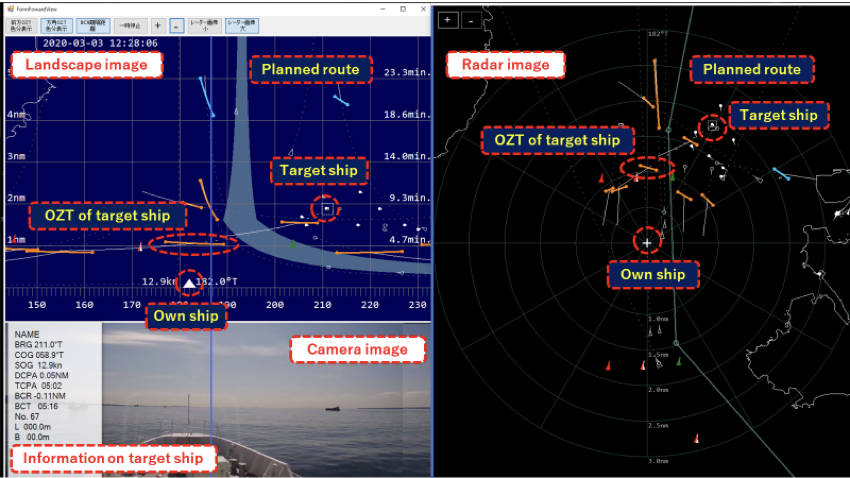
The goal of the joint study is to develop an advanced navigation support system that will lead to autonomous collision avoidance, using rule-based artificial intelligence and deep reinforcement learning algorithm. This will enable systems to estimate several Obstacle Zones by Target (OZT) among different ships and propose a route that minimizes the risk of a collision.
Demonstration testing with Tokyo University of Marine Science and Technology’s Shioji Maru has been conducted in congested sea areas such as Tokyo Bay as a part of continuous efforts to develop computational algorithms using OZT and avoidance route computational algorithms. The test confirmed the ability to estimate OZT targeting several target ships in actual operation and develop and suggest avoidance routes in real time onboard and verified the system’s effectiveness in supporting collision avoidance. The test also aimed to develop a collision avoidance system that realizes medium-to-long-term strategies for avoidance navigation well before target ships pose a risk in congested sea lanes, and takes into consideration the experience of maritime officer and other personnel in terms of safety and security.
This study advances the system’s development of Assessment in MOL’s initiative on autonomous navigation.
MOL has moved ahead with advanced support of safe operation and reduction of its environmental impact, as set out in the "ISHIN NEXT-MOL SMART SHIP PROJECT-," started in November 2016, and aims to become customers' first choice as a logistics partner by applying ICT technology to improve service quality and efficiency.
Similar Stories

DNV verifies Syroco’s method for estimating savings from voyage optimization
View ArticleHow El Niño 2026 could reshape global shipping operations
Five major shipping corridors face distinct operational impacts through the 2026 El Niño season, according to analysis published by Sofar Ocean.
View Article
Port of San Diego approves new bulk sugar import facility
View Article[Freightos Weekly Update] Ocean rates steady as shippers brace for July hikes
US-Iran negotiations toward a final peace deal continue, sometimes under fire, as Iran escalates steps aimed at establishing itself as the sole authority over the Strait of Hormuz, leading to…
View Article
cargo-partner powers European automotive supply chains via Dunajská Streda Rail Hub
View Article
AI, smart logistics and port modernization drive the future of the shipping containers market
View ArticleGet the most up-to-date trending news!
SubscribeIndustry updates and weekly newsletter direct to your inbox!
Follow us on social media:


