
US trade deficit narrows most on record on muted China imports

by Bloomberg Jun 07, 2022
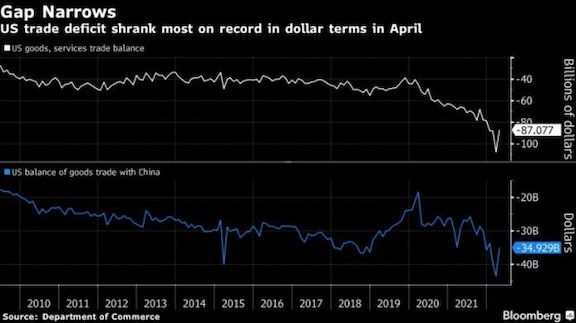
The US trade deficit shrunk in April by the most on record in dollar terms, reflecting a drop in the value of imports amid Covid lockdowns in China while exports climbed.
The gap in goods and services trade narrowed $20.6 billion, or 19.1%, to $87.1 billion, Commerce Department data showed Tuesday. The median estimate in a Bloomberg survey of economists called for an $89.5 billion deficit. The figures aren’t adjusted for inflation.
Imports dropped in April as factory activity in China fell to the lowest level since February 2020 amid strict lockdowns to curb the spread of Covid-19. While manufacturing in the country has improved somewhat since, the measures are still straining already-tenuous global supply chains, especially when coupled with Russia’s war in Ukraine.
The deficit with China decreased in April by $8.5 billion, the most in seven years. Imports dropped $10.1 billion, also the most since 2015.
Decades-high inflation is expected to weigh on trade this year, with the World Trade Organization cutting its forecast for growth in global merchandise volumes. So far though, in the US, that hasn’t materialized yet, judging by the near-record amounts of goods that arrived at the ports of Los Angeles and Long Beach in April.
In the first quarter, the widening of the trade deficit largely explained the economy’s worst performance since the pandemic recovery began, with gross domestic product shrinking at a 1.5% annual pace. That’s because the value of products American businesses and consumers bought from overseas outpaced purchases of US goods and services by other economies.
The value of imports of goods and services decreased 3.4% in April to $339.7 billion, the first drop since July in a broad-based decline. Exports increased 3.5% to a record $252.6 billion.
US merchandise imports plunged from a record in March, dropping 4.4%, the most since April 2020, reflecting a decline in inbound shipments of consumer goods, industrial supplies, capital goods and automobiles.
Retailers like Target Corp. and Walmart Inc. are trying to offload excess inventory, accumulated in part as consumers shift more of their spending from goods to services. That may portend fewer imports going forward.
On an inflation-adjusted basis, the April merchandise-trade deficit narrowed 14.2% to $116.2 billion.
Digging Deeper
- The nominal merchandise-trade deficit narrowed to $107.7 billion
- Travel exports—or spending by visitors to the US—rose to $10.7 billion, the highest since February 2020
- Travel imports, a measure of Americans traveling abroad, climbed for a third month to $8.3 billion, also the most since the onset of the pandemic
Bloomberg
© Bloomberg
The author’s opinion are not necessarily the opinions of the American Journal of Transportation (AJOT).
Similar Stories
CMA CGM PSS - From Northeast Asia to West Africa
In a continued effort to provide customers with reliable and efficient services, CMA CGM informs its customers of the following Peak Season Surcharge (PSS).
View ArticleCMA CGM PSS - From Far East to the Mediterranean & North Africa 2026
In a continued effort to provide customers with reliable and efficient services, CMA CGM informs its customers of the following Peak Season Surcharge (PSS).
View ArticleCMA CGM: PSS - From China & Southeast Asia to West Africa
In a continued effort to provide customers with reliable and efficient services, CMA CGM informs its customers of the following Peak Season Surcharge (PSS).
View ArticleTrade Unions united in Madrid for a democratic Europe
On 18 June, ETUC, CCOO and UGT brought together trade unions in the Spanish capital for a major mobilization.
View Article
Suspension of de minimis in EU: what awaits China-Europe e-commerce trade?
View Article
US-Iran deal to reopen Strait of Hormuz— but full container shipping recovery at least three months away
View ArticleGet the most up-to-date trending news!
SubscribeIndustry updates and weekly newsletter direct to your inbox!
Follow us on social media:


