
The largest coal-fired power plant in Pennsylvania will close by July 2023
Jun 05, 2023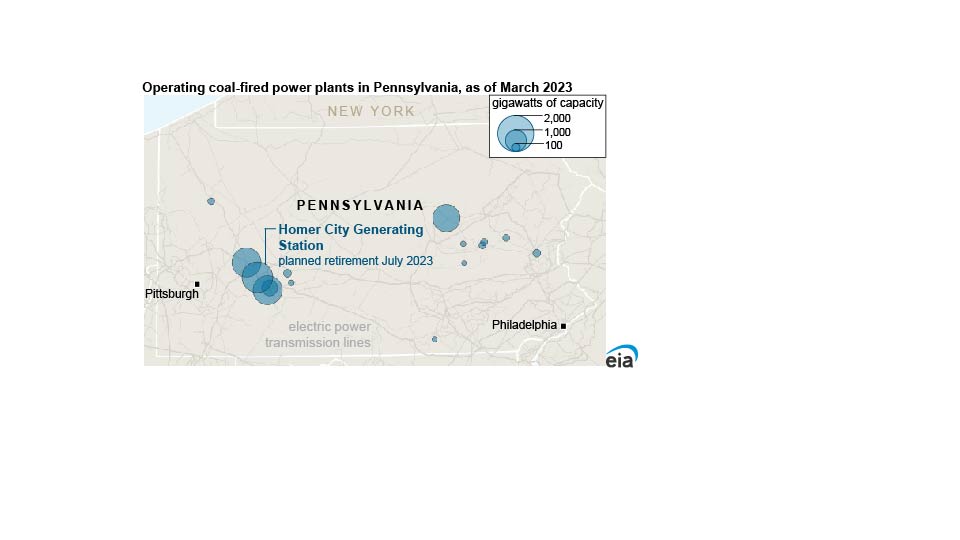
After 54 years of providing power to Pennsylvania and New York, the Homer City Generating Station in Pennsylvania will close by July 2023, according to the plant’s owner. The 1,888 megawatt coal plant began generating electricity in 1969, when Units 1 and 2 entered service. Unit 3 was added in 1977.
Coal plants across the country are retiring; U.S. coal-fired capacity has contracted from 313 gigawatts (GW) in 2005 to around 196 GW today. The Homer City coal-fired power plant was built before the turn of the century and was designed to provide base load power, operating nearly continuously to meet the minimum amount of regional power demand. Recently, coal plants have struggled to effectively compete in competitive U.S. power markets against newer, more efficient, natural gas-fired, combined-cycle power plants.
The Homer City plant was built near coal reserves and included what was then a high-capacity (345 kilovolt) transmission line to service areas in western New York and eastern Pennsylvania. For 30 years, the plant operated almost continuously, achieving a utilization rate, called a capacity factor, near 90%.
In 1999, the Homer City plant sold for $1.8 billion, corresponding to a period when Pennsylvania was deregulating its electricity market. At that time, coal-fired generation accounted for about 53% of the nation’s power supply; natural gas only accounted for about 12%. Since then, those roles have nearly reversed; natural gas is now the source of 40% of the electricity in the United States, and coal has dropped to 20%.
The market landscape changed for the Homer City plant at the turn of the century. New emissions standards for power plants under the Clean Air Act required the plant to install FGD scrubbers on Unit 3 in 2001 and on Units 1 and 2 in 2014. Pollution control upgrades in 2014 cost the plant owners a reported $750 million. Ownership of the plant changed after bankruptcy in 2017.
Driven by the ramp up of drilling and fracking to produce natural gas from the Marcellus and Utica shale formations in the region, many new natural gas-fired power plants were built in Pennsylvania. As new natural gas-fired plants were built, the Homer City plant was dispatched more intermittently for load following instead of for base load. This change increased annual maintenance costs for the Homer City plant, on top of the debt incurred from the pollution control upgrades.
Load-following plants adjust their power output as demand for electricity fluctuates throughout the day and by season. In contrast, base load power plants are usually run at near maximum output and are only taken offline to perform annual maintenance or repairs. As the Homer City plant became less competitive economically and was dispatched for load following rather than for base load power, the plant generated less electricity, and its capacity factor dropped. The Homer City plant was operated at an annual capacity factor of 82% in 2005. The capacity factor dropped to 20% in 2022, contributing in the decision to retire the plant.

Similar Stories

Metered electricity demand in the New York ISO falls midday because of small-scale solar
View Article
U.S. commercial crude oil inventories have decreased in June
View Article
Fuel cell investment by data centers set to grow tenfold, reaching $30 billion by 2030
View Article
Two monopile handling innovations boost Baltic Power offshore wind farm
View ArticleThe Danish Maritime and Commercial High Court rules in favor of Ørsted in cases concerning the former Elsam
Today, the Danish Maritime and Commercial High Court has delivered its judgement in favour of Ørsted in six cases, where the plaintiffs have claimed damages totalling up to DKK 416…
View Article
Middle East oil supply predicted to recover by end of ‘26, faster than expected – Rystad Energy oil market note
View ArticleGet the most up-to-date trending news!
SubscribeIndustry updates and weekly newsletter direct to your inbox!
Follow us on social media:


