
Port of Kapellskär has Sweden’s first suction mooring
Oct 02, 2023Port of Kapellskär has welcomed the new Finnlines vessel with brand new technology. The port now offers automooring using vacuum pads, as well as next generation onshore power connections. This makes mooring more efficient and improves the sustainability.
Mid-September was the premier of Sweden's first automooring of a vessel using vacuum technology. The brand new Finnlines vessel, M/S Finnsirius, which operates on the Kapellskär – Långnäs – Naantali route, now docks using vacuum pads. The pads can dock and undock the vessel in less than 30 and 15 seconds, respectively.
“Together with Finnlines, we have planned and updated Port of Kapellskär with brand new technology before the brand new Finnlines vessel arrived. Automooring using vacuum technology improves sustainability by providing a safer working environment and reduced environmental impact," says Johan Wallén, Chief Commercial Officer at Ports of Stockholm.
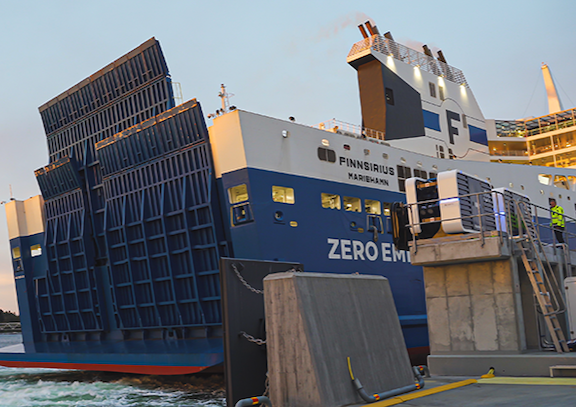
Automooring with vacuum technology eliminates the risk of injury, as it is work handling conventional mooring lines, that carries the greatest injury risk during a vessel call. Operative efficiency is also improved as the mooring time is reduced. The vessels engines can be stopped earlier, which leads to a significant fuel saving and reduced NOx and CO2 emissions, especially when combined with connection to onshore power.
M/S Finnsirius also connects to onshore power at Port of Kapellskär using a next generation crane, a PowerReach NxG. A lot of power can be transferred using this system. The voltage capacity is 11,000 volts, or 11kV, which delivers power of up to 4 MVA. This is the combined electricity consumption equivalent of 1,000 households.
Connecting to onshore power enables a significant fuel saving, as the vessel's auxiliary engines do not need to be used at the quayside. This reduces NOx and CO2 emissions. The work environment is also improved, as the noise levels and vibrations from the vessel are reduced. The lower noise levels also have a positive impact on the surrounding environment.
Ports of Stockholm began to provide onshore power connections for vessels in the 1980s and all of its ports are now equipped with onshore power connection facilities.
The facilities for onshore power connection and automated mooring at Port of Kapellskär is partly financed by the EU, within the framework of the EU project "Upgrade of the Baltic sea bridge Kapellskär–Naantali (MoS Finnlink)." The onshore power connection project also has funding from the Swedish national Climate Leap investment project.
Similar Stories

Governor Moore leads ribbon-cutting of double-stack rail operations at Port of Baltimore
View Article
Port of Long Beach volumes surge 32% in May
View Article
Freight Summit highlights urgent need for inland waterways investment to strengthen U.S. supply chains
View Article
OOCL announces new China Australia Express Loop (A3X)
View Article
MSIG USA appoints marine industry leader Scott head of cargo and logistics
View Article
Pacific International Lines accelerates fleet renewal
View ArticleGet the most up-to-date trending news!
SubscribeIndustry updates and weekly newsletter direct to your inbox!
Follow us on social media:


