
How the trade war has led to higher food prices
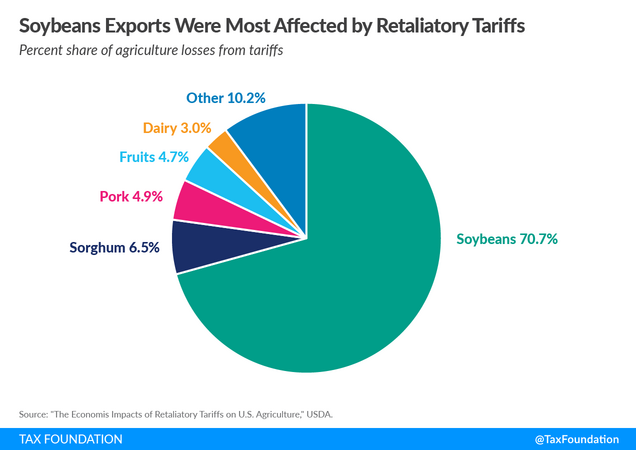
Jul 27, 2022With inflation continuing to skyrocket, especially for food, the Tax Foundation released a new post today examining how the Trump trade war and retretaliatory tariffs have hurt U.S. agricultural and food prices.
Key points:
$30 billion in U.S. ag products were targeted: In response to the U.S. imposition of tariffs by the Trump administration on Chinese imports (plus tariffs on steel and aluminum), China and other countries responded with several waves of tariffs on U.S. exports.
• China represents the U.S.’s largest agricultural export market, a large percentage of agricultural goods, including soybean and pork exports, faced tariffs.
• Other countries also retaliated against the U.S.
• Across all retaliatory tariffs, $30 billion in agricultural products were targeted, or about 22 percent of all retaliated goods.
U.S. lost nearly $16 billion in trade: A U.S. Department of Agriculture study found the retaliatory tariffs reduced U.S. agricultural exports by $27 billion. The losses were primarily concentrated in states such as Iowa, Illinois, and Kansas.
• In these three states alone, GDP losses totaled $3.8 billion through 2019.
• Altogether, the U.S. lost nearly $16 billion in trade with retaliatory countries due to these tariffs.
Direct Hits on Certain Items: The Trump administration’s tariffs on Chinese imports primarily targeted intermediate goods, or goods used in the production process of consumption goods, but some tariffs hit food directly. For example, the third tranche of tariffs enacted in September 2018, totaling $200 billion, hit a wide batch of goods including seafood.
• Most seafood imported from China is actually farmed in the U.S., but because it is packaged in China, this qualifies as a “substantial transformation” under U.S. trade law and gets labeled as a Chinese good.
• This has significantly impacted the fishing industry in Alaska, and led to increased imports of seafood from Russia at a time when U.S.-Russia relations are strained due to the ongoing Russia-Ukraine war.
"The trade war has failed to generate benefits for U.S. industries," said Alex Durante, a federal economist at the Tax Foundation. "The Biden administration should help farmers by negotiating with China and other countries to lower or rescind the tariffs altogether and focusing on more constructive trade polices to promote U.S. economic growth."
Similar Stories
US, Australia sign Customs Mutual Assistance Agreement
CMAA enhances trade and security cooperation
View ArticleWorld Shipping Council releases Containers Lost at Sea Report: 2026 Update
The World Shipping Council has released its annual Containers Lost at Sea Report, showing that an estimated 1,478 containers were lost at sea in 2025 out of approximately 280 million…
View ArticleXeneta weekly Ocean Container Shipping Market Update
It has been a long time coming, but carriers have finally responded to spiraling spot rates and supply chain disruption on major ocean container shipping trades out of Asia by…
View Article
North American Transborder Freight increased 19.4% in April 2026 from April 2025
View Article
‘China Shock 2.0’: EU primed for action?
View Article
Port of Hamburg strengthens partnership with China
View ArticleGet the most up-to-date trending news!
SubscribeIndustry updates and weekly newsletter direct to your inbox!
Follow us on social media:


