Global trade in 2025: Resilience under pressure
Mar 14, 2025
Global trade started 2025 on stable ground, but challenges are mounting. The latest Global Trade Update by UN Trade and Development (UNCTAD), covering data through early March, signals a shifting landscape. In 2024, world trade saw record expansion to $33 trillion in 2024 – up 3.7% from 2023 – driven by developing economies and strong services trade. But looking ahead, new risks loom, including trade imbalances, evolving policies, and geopolitical tensions.
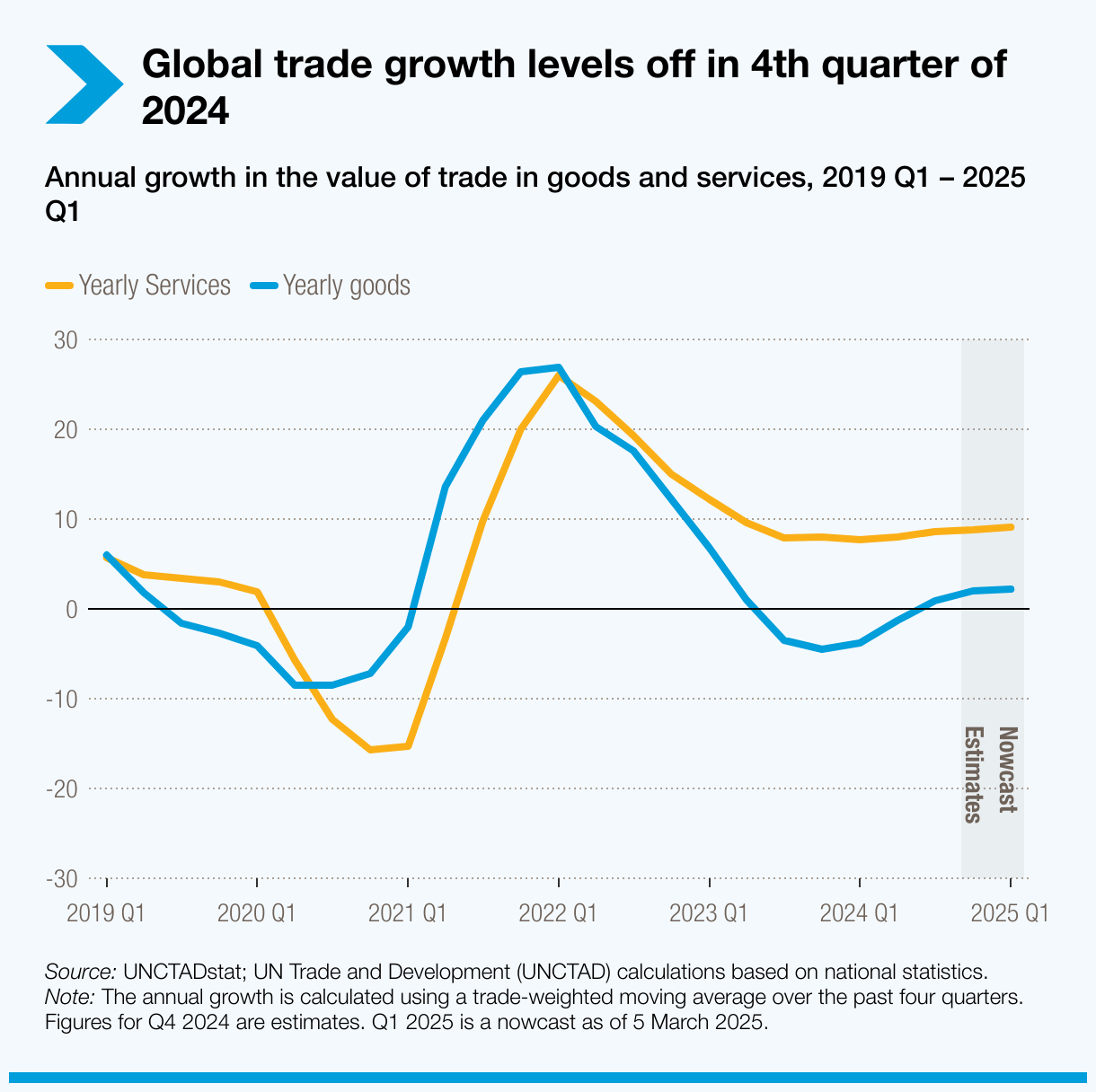
Global trade growth levels off in 4th quarter of 2024
Annual growth in the value of trade in goods and services, 2019 Q1 – 2025 Q1
Yearly ServicesYearly goods2019 Q12020 Q12021 Q12022 Q12023 Q12024 Q12025 Q1-30-20-100102030Yearly goods2019 Q3-1.6Yearly goods2019 Q3-1.6EstimatesNowcastSource: UNCTADstat; UN Trade and Development (UNCTAD) calculations based on national statistics.Note: The annual growth is calculated using a trade-weighted moving average over the past four quarters. Figures for Q4 2024 are estimates. Q1 2025 is a nowcast as of 5 March 2025.
The gap between developing and advanced economies is widening. Asia and Latin America remain key trade drivers, but growth has slowed in many advanced economies. South-South trade is holding up, yet Africa’s intra-regional trade is shrinking, reversing gains. Meanwhile, trade between Europe and Central Asia has declined, reflecting shifting demand.
Supply chains diversify, not consolidate
Nearshoring and friendshoring trends reversed in 2024, as businesses moved beyond limiting trade to geopolitical allies or nearby regions. Instead of consolidating supply chains, firms are now diversifying trade networks across multiple regions to reduce risk – creating opportunities but adding complexity.
Trade dependence is also shifting. Economies such as Russia, Viet Nam, and India, have deepened trade ties with specific partners, while others, including Australia and the EU, are reducing reliance on traditional markets. The decline in trade concentration suggests that smaller economies are playing a bigger role.
Trade policies redraw the map
Governments are expanding tariffs, subsidies, and industrial policies, reshaping trade flows. The United States, European Union (EU) and others are increasingly tying trade measures to economic security and climate goals, while China is using stimulus policies to maintain export momentum.
This policy realignment is contributing to uncertainty. Rising protectionism (policies favouring domestic industries through tariffs or restrictions), particularly in advanced economies, is triggering retaliatory measures (countermeasures from trading partners in response to trade restrictions) and adding trade barriers.
Meanwhile, industrial policies (long-term strategies to develop specific sectors) are reshaping key sectors like clean energy, technology and critical raw materials, risking competition distortion.
Global trade imbalances widen
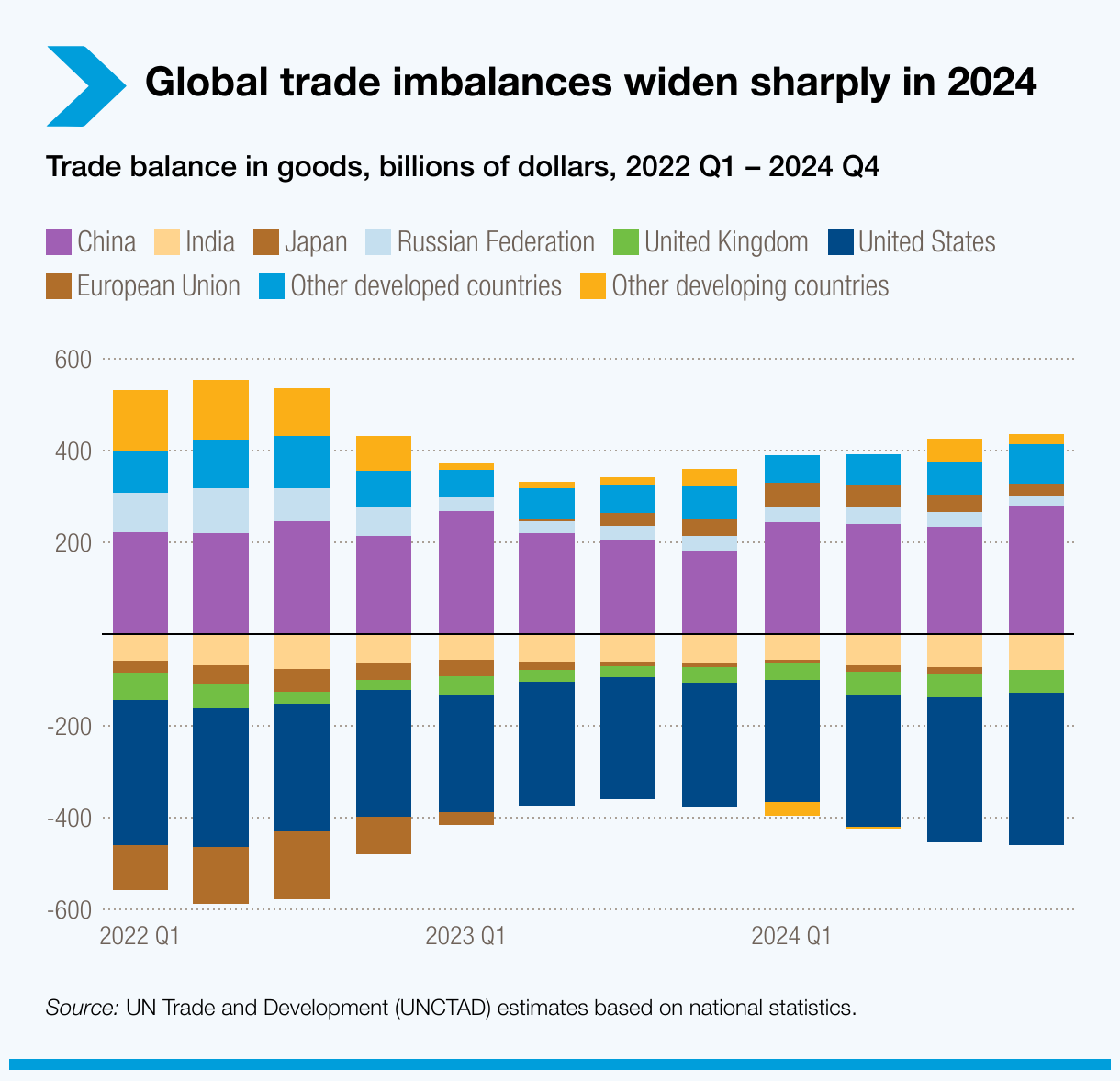
In 2024, global trade imbalances returned to 2022 levels. The US trade deficit grew, China’s surplus expanded, while the EU shifted to surplus due to energy price changes.
Bilateral gaps persist: the US-China deficit is widening, the EU’s surplus with China is growing, and India’s deficit with Russia has increased amid shifting energy trade. These trends could prompt new tariffs, restrictions, or investment shifts, adding to economic uncertainty.
Global trade imbalances widen sharply in 2024
Trade balance in goods, billions of dollars, 2022 Q1 – 2024 Q4

Uneven sector growth
Trade growth varied by industry: agri-food, communication tech, and transport saw gains, while energy, apparel, and extractives slowed due to weaker demand and policy shifts.
Shipping trends indicate a slowdown, with falling freight indices signaling weaker industrial activity, particularly in supply chain-dependent sectors.
Navigating 2025: Avoiding fragmentation
As trade uncertainty grows, global cooperation and balanced policies remain critical. While China’s stimulus measures and lower inflation in some regions could support trade, protectionism and shifting policies in major economies remain key risks.
The challenge in 2025 is to prevent global fragmentation - where nations form isolated trade blocs – while managing policy shifts without undermining long-term growth. The actions taken now by governments and businesses will shape trade resilience for years to come.
Similar Stories

Port Laredo awarded new $25 million BUILD grant to support US-Mexico trade
View Article
USMCA figures prominently at GSDF 2026 event in New York City
View Article
Steel trade closely watches Brownsville port’s channel deepening project
View Article
Florida produce sees opportunity with non-renewal of USMCA
View Article
Heightened Chinese Coast Guard patrols in Taiwan Strait may impact East Asia shipping
View Article“K” LINE to support relief efforts following earthquake off the Coast of Mindanao
The earthquake that struck off the coast of Mindanao, the Philippines, on June 8 caused severe damage in a number of regions.
View ArticleGet the most up-to-date trending news!
SubscribeIndustry updates and weekly newsletter direct to your inbox!
Follow us on social media: