
For most of 2020, China’s refineries processed more crude oil than US refineries
Mar 25, 2021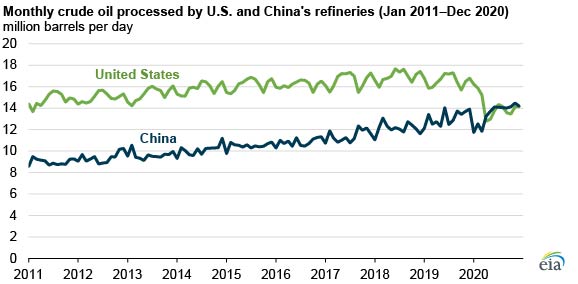
In April 2020, more crude oil was being refined in China’s refineries than in U.S. refineries for the first month on record, and the trend continued for all remaining months in 2020 except for July and August. China processed more crude oil than the United States not only because of the unique effects of COVID-19 pandemic-related restrictions in 2020, but also because of differences in the longer-term structural refining trends between the two countries.
China’s National Bureau of Statistics only reports the country’s processing volume of crude oil. The most direct comparison to the United States is refiner net inputs of crude oil. U.S. refiners also report total gross inputs into distillation units, which include non-crude liquids such as lease condensate and unfinished oils, making gross inputs about 0.5 million barrels per day (b/d) larger than net crude oil inputs. China’s crude oil processing also exceeded U.S. gross inputs in both May and October 2020.
April 2020 was the first full month for the United States in which responses to the COVID-19 pandemic reduced demand for petroleum products such as gasoline, distillate, and jet fuel. Although net inputs of crude oil to U.S. refiners had seen record declines in April, China’s crude oil processing began increasing above previous levels following a demand increase when COVID-19 cases declined in that country.
China’s refinery runs also started to rise in April 2020 partially because China implemented a policy in 2016 that encourages refiners to refine more petroleum products by fixing product prices at $40 when the Brent crude oil price falls to less than $40 per barrel (b). The Brent crude oil price fell and remained less than $40/b between March and May 2020.
While China processed a record 14.1 million b/d of crude oil in June and further rose to 14.5 million b/d in November, U.S. refinery runs have not yet returned to their March 2020 levels because of a combination of demand reductions and hurricanes in the fall that disrupted refinery processes. Hurricanes Laura and Sally in late August and September, respectively, and Hurricanes Delta and Zeta in October resulted in refinery shut-ins on the Gulf Coast, where more than half of U.S. refining capacity is located. Although some refineries came back online in late 2020, U.S. refinery runs remained lower than historical averages in 2020.
Similar Stories
How the US-Iran scenarios shape Brent prices - Rystad Energy’s Oil Market Update
The oil market is shifting rapidly away from the simple question of whether the Strait of Hormuz reopens.
View Article
Port of Long Beach, MARAD sign first-of-its-kind partnership agreement on nuclear energy in maritime
View Article
DOT and Port of Long Beach sign agreement to test nuclear-powered vessels
View ArticleSPIRO publishes its first Sustainability Report
SPIRO published its inaugural Sustainability Report.
View Article
Latest Bureau Veritas approvals strengthen confidence in Anemoi Rotor Sail technology
View Article
Arc joins the Maritime Battery Forum
View ArticleGet the most up-to-date trending news!
SubscribeIndustry updates and weekly newsletter direct to your inbox!
Follow us on social media:


