
CO2 emissions prices in the Northeast states reached record levels in most recent auction
Mar 23, 2021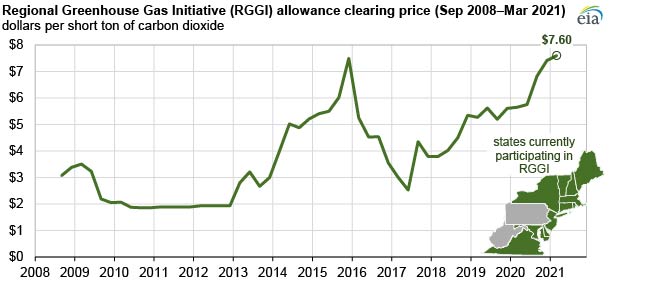
The most recent Regional Greenhouse Gas Initiative (RGGI) quarterly auction, held on March 3, 2021, resulted in a clearing price of $7.60 per short ton of carbon dioxide (CO2), surpassing the previous high price of $7.50 per short ton reached in December 2015. States can reinvest the proceeds from these auctions in consumer benefit programs to improve energy efficiency and accelerate the deployment of renewable energy technologies in the electric power sector.
The RGGI agreement was the first in the United States to place a cap on power sector CO2 emissions. The original RGGI member states are Connecticut, Delaware, Maine, Maryland, Massachusetts, New Hampshire, New Jersey, New York, Rhode Island, and Vermont.
In January 2021, Virginia became a full participant in the RGGI CO2 emission allowance market. New Jersey withdrew from the program in 2012 but rejoined in January 2020. The Pennsylvania Department of Environmental Protection’s plan to join RGGI has encountered opposition from the state legislature.
RGGI is implemented through individual CO2 Budget Trading Programs in each participating state. The RGGI-wide CO2 cap represents a regional budget for CO2 emissions from the power sector and is an aggregation of the individual state program targets. As states join or leave RGGI, the aggregated caps are modified to reflect those changes.
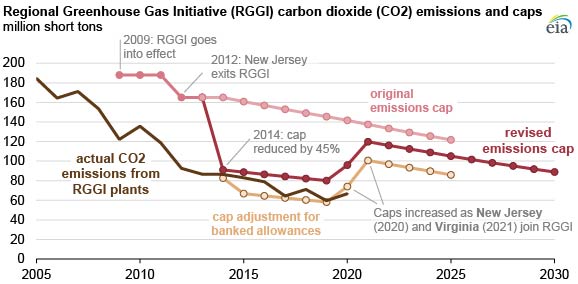
For most of its early years, the RGGI program has registered emissions that are much lower than the allocated limits. The original cap was 188 million short tons of CO2 per year in the first three years of the program: 2009 through 2011. In those years, actual emissions averaged 126 million short tons per year, or one-third less than the cap. The cap was lowered in 2012 and 2014, but emissions have consistently been less than the caps.
RGGI’s emissions cap increased from 96 million short tons in 2020 to about 120 million short tons in 2021. Most of that increase was to accommodate Virginia when it entered RGGI in January 2021. RGGI’s plan allows for overall emissions caps to decline (tighten) from 2021 through 2030.
Similar Stories

Port of Long Beach, MARAD sign first-of-its-kind partnership agreement on nuclear energy in maritime
View Article
DOT and Port of Long Beach sign agreement to test nuclear-powered vessels
View ArticleSPIRO publishes its first Sustainability Report
SPIRO published its inaugural Sustainability Report.
View Article
Latest Bureau Veritas approvals strengthen confidence in Anemoi Rotor Sail technology
View Article
Arc joins the Maritime Battery Forum
View Article
2.5 million bpd of Saudi oil at risk as Houthis threaten to enact naval blockade – Rystad Energy market note
View ArticleGet the most up-to-date trending news!
SubscribeIndustry updates and weekly newsletter direct to your inbox!
Follow us on social media:


