
Brazil was the only South American country to increase crude oil production in 2020
Dec 06, 2021Brazil was the only oil-producing country in South America to report an increase in crude oil and condensate production in 2020 compared with 2019, according to our Country Analysis Brief: Brazil, which we updated this summer. In 2020, Brazil produced an average of 2.94 million barrels per day (b/d) of crude oil and condensate, an increase of more than 150,000 b/d on average compared with 2019.
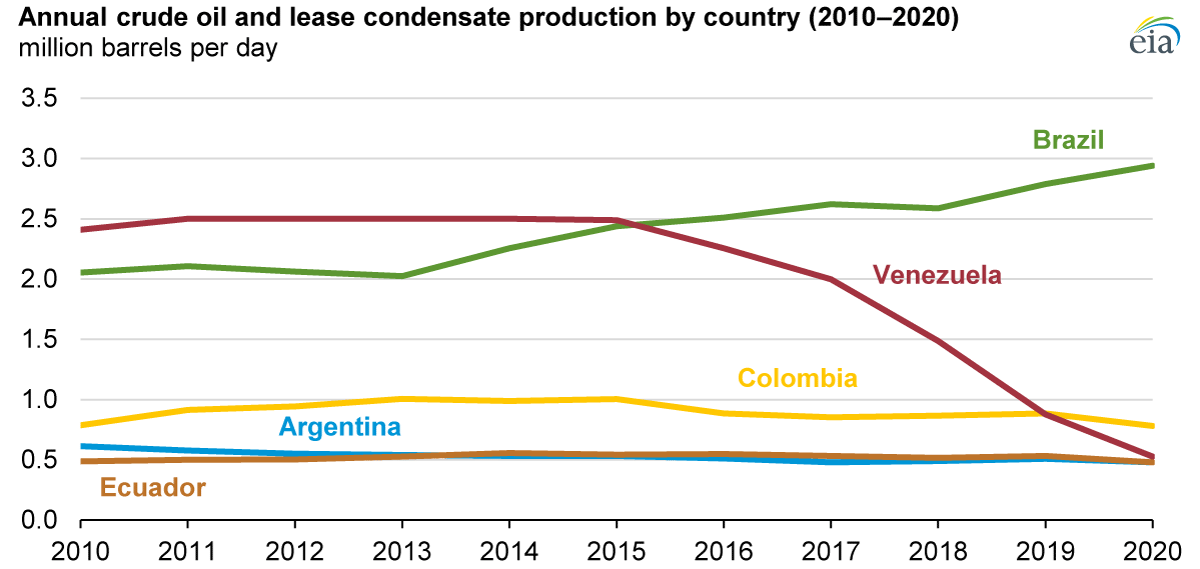
Brazil increased its petroleum production in 2020 despite the drop in global petroleum demand caused by the COVID-19 pandemic. Petroleum production in other South American countries, such as Ecuador, fell year over year in 2020. We expect Brazil's production to continue to grow, contributing to global petroleum production growth in 2021, according to our November Short-Term Energy Outlook.
The Oil & Gas Journal estimates that as of January 2021, Brazil had 12.7 billion barrels of proved oil reserves, the second-largest oil reserves in South America after Venezuela.
Within the last two years, Brazil’s state-controlled Petróleo Brasileiro S.A. (commonly known as Petrobras) has significantly increased the number of production vessels operating in its pre-salt fields to boost crude oil production. Pre-salt oil refers to oil reserves that are exceptionally deep below the ocean under thick layers of rock and salt. The great depth and pressure involved in pre-salt production present significant technical hurdles. The company has overcome previous technological difficulties for drilling in deep water.
Petrobras is the main participant in Brazil’s upstream, midstream, and downstream oil sector activities. The company held a monopoly on oil-related activities in Brazil until 1997, when the government opened the sector to competition.
The Agência Nacional do Petróleo, Gás Natural e Biocombustíveis (ANP) is responsible for issuing exploration and production licenses and ensuring compliance with relevant regulations. In 2018, the ANP loosened rules that set the minimum percentages of the locally sourced goods and services required in exploration and production contracts. These changes could significantly affect Brazil’s growth in oil production in the future. Breakeven prices could fall significantly and lead to increased oil production. Producers saw Brazil’s previous local content rules as a disincentive for investment because of the limited and uncompetitive local supply chain, according to Business News Americas.
Principal contributors: Natalie Kempkey, Kimberly Peterson
Similar Stories

DOT and Port of Long Beach sign agreement to test nuclear-powered vessels
View ArticleSPIRO publishes its first Sustainability Report
SPIRO published its inaugural Sustainability Report.
View Article
Latest Bureau Veritas approvals strengthen confidence in Anemoi Rotor Sail technology
View Article
Arc joins the Maritime Battery Forum
View Article
2.5 million bpd of Saudi oil at risk as Houthis threaten to enact naval blockade – Rystad Energy market note
View Article
JB Hunt reports second quarter 2026 results
View ArticleGet the most up-to-date trending news!
SubscribeIndustry updates and weekly newsletter direct to your inbox!
Follow us on social media:


