
Port of Rotterdam & Shell lead with new green hydrogen generation

by Stas Margaronis Jun 29, 2022
At the Port of Rotterdam, Shell will soon begin construction of a facility that will provide green hydrogen.
Initially, the hydrogen will be used for internal use but as demand increases, future hydrogen supplies will power the European transportation sector.
In April the Port of Rotterdam announced that “Shell is the first company to sign an agreement to use … the hydrogen pipeline in the port of Rotterdam that Gasunie is laying in collaboration with the Port of Rotterdam Authority from the Maasvlakte to Pernis in order to make the industry in the port more sustainable.”
The release went on to say: “Shell becomes the pipeline’s first customer. …The hydrogen pipeline will be in use at the end of 2024, early 2025. In time, the pipeline will be connected to the national and international hydrogen network.
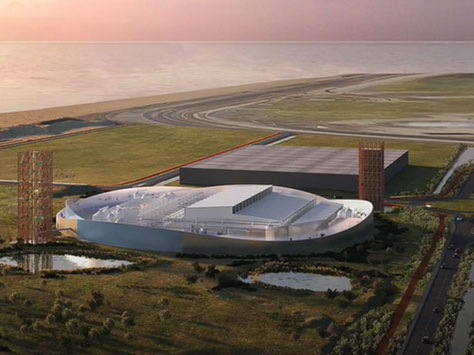
The Port of Rotterdam has established the groundwork for a new, green hydrogen complex in which nearby windfarms located in the North Sea will connect to the complex to support electrolysis that creates renewable energy-based hydrogen fuel.
According to the U.S. Department of Energy: “Electrolysis is a process that splits hydrogen from water using an electric current. Electrolysis is commonly used to demonstrate chemical reactions and hydrogen production in high school science classes. On a large, commercial scale, the process may be referred to as power-to-gas, where power is electricity and hydrogen is gas. Electrolysis itself does not produce any byproducts or emissions other than hydrogen and oxygen. The electricity for electrolysis can come from renewable sources, nuclear energy, or fossil fuels.”
The Port says it has attracted several companies to create a conversion park that will utilize windfarm electricity to create the hydrogen. The Port expects to ramp up production of green hydrogen as higher demand lowers the price of hydrogen fuel in the next ten years.
The Port says the advantages of establishing a hydrogen hub in Rotterdam are many: “Large-scale use of hydrogen in industry can considerably reduce carbon emissions. A hydrogen network will also enable the port to continue to play a leading role internationally, as well as remain the motor of the national economy.”
The Port says there is an increasing role for hydrogen: “As well as being a replacement for natural gas in generating heat in the process industry, hydrogen is also a building block for the manufacture of products in the sustainable chemical industry. Hydrogen is also developing as an important energy carrier in aviation, shipping and heavy road transport, and will also be used to heat homes and greenhouses.”
Conversion Park
Sjaak Poppe, spokesman for the Port of Rotterdam on energy transition, took AJOT on a tour of the site located at the Maasvlakte complex which hosts container terminals, distribution center and soon a new hydrogen conversion park:
“The ‘Conversion Park’ as we call it, is some 25 hectares. Of those 17 hectares is dedicated for several companies that will use electrolysis to create the green hydrogen. The rest of the area will be occupied by an electricity substation, (future) residual heat station, and a DC-AC conversion station operated by TenneT high voltage national network operator.”
TenneT is a leading European electricity transmission system operator (TSO) with its main activities in the Netherlands and Germany. With over 23,900 kilometers of high-voltage connections. It provides a supply of electricity to 42 million end-users.
Residual heat is a by-product of electrolysis and an additional energy source, Poppe explained. He said that “next, we reserved an area for residual heat because with electrolysis you lose about 25% of the energy. You can’t transform all the energy from electricity into hydrogen. You lose about 25% of it in cooling water, which still is high enough to heat green houses or houses.”
Other Port of Rotterdam Electrolyzer Companies
Aside from Shell’s projected 200 MW of capacity, other electrolyzer companies that will be building new facilities at the Port of Rotterdam conversion site are Air Liquide with 200 MW of capacity and H2-Fifty with 250 MW of capacity.
Stas Margaronis
Stas Margaronis is a maritime journalist, publisher, and trade industry expert with more than 40 years of experience covering global transportation, ports, logistics, and infrastructure. He serves as California Ports Reporter for the American Journal of Transportation (AJOT), reporting on maritime trade, tariffs, and port developments across California’s major seaports. Margaronis is also President of the Propeller Club of Northern California and publisher of Rebuild the United States (RBTUS), covering infrastructure, shipbuilding, cybersecurity, AI, and national security. His background includes international trade, logistics management, and publishing, with experience spanning the United States and Asia.
Similar Stories

Before 2026 diesel spike: US zero emission trucks deployments were rising
View Article
bound4blue eases eSAIL® adoption with ABS review of Pwind calculation methodology
View Article
A mobile green hydrogen refueling station enables the immediate deployment of a hydrogen bus fleet in Northern Germany
View Article
Port of Maputo launches Mozambique’s first Port Community System initiative; Kalé selected as technology partner
View Article
Weber takes over at the Hupac Group
View Article
U.S. refinery capacity has dropped from 2025 to 2026
View ArticleGet the most up-to-date trending news!
SubscribeIndustry updates and weekly newsletter direct to your inbox!
Follow us on social media:


