
Port of Los Angeles, Toyota and Kenworth partner on hydrogen fuel cell Class 8 trucks

by Stas Margaronis Jun 07, 2021
Under the $82.5 million Shore-to-Store (S2S) project, the Port of Los Angeles and more than a dozen public and private sector partners have teamed up for a 12-month demonstration of zero-emission Class 8 trucks and will expand the project to include five more hydrogen-fueled heavy-duty trucks, two battery-electric yard tractors, and two battery-electric forklifts, according to a June 7th Port announcement.
“Transporting goods between our Port and the Inland Empire is the first leg of this next journey toward a zero-emissions future,” said Port of Los Angeles Executive Director Gene Seroka. “This project is a model for developing and commercializing the next generation of clean trucks and cargo-handling equipment for the region and beyond. Just as the air we breathe extends beyond the Port’s footprint, so should the clean air and economic benefits we believe this project will yield.”
The Port’s technology development partners are Toyota Motor North America, which designed and built the powertrain’s fuel cell electric power supply system; Kenworth Truck Co., which designed and built the Class 8 trucks with Toyota’s fuel cell electric system; and Shell Oil Products US (Shell), which designed, built and will operate the project’s two new high-capacity hydrogen fueling stations in Wilmington and Ontario.
“The innovative Shore-to-Store program is helping pave the way toward commercialization of fuel cell electric technology in the transportation sector,” said Bob Carter, Executive Vice President, Sales, Toyota Motor North America. “By utilizing this technology, port operators like our own Toyota Logistics Services (TLS) can utilize a zero-emissions and scalable solution for CO2 reductions, which will contribute to cleaner air at the port and the surrounding communities where TLS operates. This is an important milestone in Toyota’s drive toward carbon neutrality.”
Toyota says the trucks have the ability to travel 300 miles on one charge of hydrogen.
In May, AJOT reported that Corvus, the Norwegian-Canadian marine battery maker will use Toyota fuel cell technology as a building block for the propulsion of vessels.
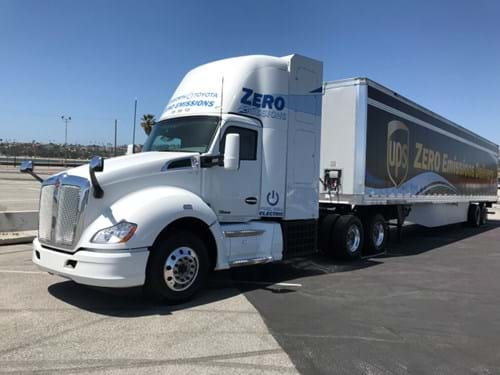
Getting e-Trucks Into Service
Toyota also builds the hydrogen fuel cell powered automobile, the Mirai.
The partners operating the trucks are Toyota Logistics Services (TLS), UPS, and trucking companies Total Transportation Services Inc. (TTSI) and Southern Counties Express (SCE).
“Getting these trucks into service is another positive step for this groundbreaking program”, said Gordon Reimer, President, Southern Counties Express. “We have been involved with this project since the beginning, so we are excited to see the continued progress of this technology.”
The Port’s technology development partners are Toyota Motor North America, which designed and built the powertrain’s fuel cell electric power supply system; Kenworth Truck Co., which designed and built the Class 8 trucks with Toyota’s fuel cell electric system; and Shell Oil Products US (Shell), which designed, built and will operate the project’s two new high-capacity hydrogen fueling stations in Wilmington and Ontario, California.
“For generations, neighborhoods located next to high volume traffic corridors have experienced disproportionately high rates of air pollution and pollution-related illness, particularly in the greater Los Angeles region,” said California Air Resources Board Deputy Executive Officer Craig Segall. “We are working steadily to change this trajectory by helping to fund, support and promote comprehensive efforts like the Port of L.A.‘s Shore-to-Store Project…”
The Port of Los Angeles’ S2S Project is part of California Climate Investments, a statewide initiative that puts billions of Cap-and-Trade dollars to work reducing greenhouse gas emissions.
Stas Margaronis
Stas Margaronis is a maritime journalist, publisher, and trade industry expert with more than 40 years of experience covering global transportation, ports, logistics, and infrastructure. He serves as California Ports Reporter for the American Journal of Transportation (AJOT), reporting on maritime trade, tariffs, and port developments across California’s major seaports. Margaronis is also President of the Propeller Club of Northern California and publisher of Rebuild the United States (RBTUS), covering infrastructure, shipbuilding, cybersecurity, AI, and national security. His background includes international trade, logistics management, and publishing, with experience spanning the United States and Asia.
Similar Stories

Port of Oakland cargo volumes rise in June on import and export growth
View Article
Strong growth in earnings for global terminal operators has led to a surge in capital investment
View Article
Port of Brownsville announces Saronic Technologies partnership
View Article
Circle Logistics Highlights Drayage Capabilities to Meet Surging Demand at U.S. Ports
View Article
Port of Long Beach Receives Edmund G. ‘Pat’ Brown Award
View Article
Port of Corpus Christi names Yudi Takizawa Chief Commercial Officer
View ArticleGet the most up-to-date trending news!
SubscribeIndustry updates and weekly newsletter direct to your inbox!
Follow us on social media:


