
US trade deficit narrowed last year by the most since 2009

by Bloomberg Feb 07, 2024
The US trade deficit narrowed last year by the most since 2009 as the value of imported goods declined and the services surplus increased.
The annual trade shortfall shrank nearly 19% to $773.4 billion from a record in 2022, Commerce Department data showed Wednesday. In December, the deficit in goods and services trade widened slightly from the prior month to $62.2 billion. The figures aren’t adjusted for inflation.
The narrowing of the US trade gap was the first in four years and reflected efforts by companies to limit the buildup in inventories, restraining demand for imports. American consumers’ spending preferences continued to shift toward services and experiences after a pandemic-driven binge on merchandise.
A smaller trade deficit also helped contribute to economic growth. Net exports have added to gross domestic product for seven straight quarters. From the third quarter of 2020 through the start of 2022, trade subtracted from GDP.
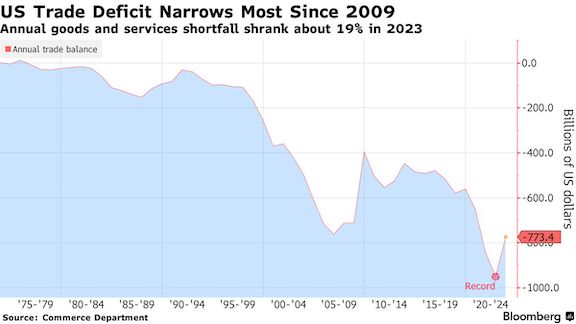
On an inflation-adjusted basis, the merchandise trade deficit narrowed to $82.8 billion in December from a month earlier.
Annual Highlights (unadjusted for inflation)
- The value of imports fell 3.6%, while exports of goods and services increased 1.2% to a record high
- US petroleum surplus climbs to record $30.1 billion
- Capital goods, consumer goods, motor vehicle exports were highest ever
- Exports of foods & feed lowest since 2020
- Imports of consumer goods declined to lowest since 2020
As supply chains continued to untangle after being thrown into disarray by the pandemic, pressure eased on US companies to stockpile materials and finished goods. Firms also revamped their logistics networks to allow them to better weather supply disruptions in a specific region or country.
A more complex global trading system is showing through in US bilateral trade figures. The nation’s merchandise deficit with China last year shrank 27% to an unadjusted $279.4 billion, the smallest since 2010. The narrowing was the largest in data back to 2002.
At the same time, the gap with Mexico grew to a record $152.4 billion.
US trade shortfalls also reached annual records with Germany, South Korea, Taiwan, India and Italy.
Bloomberg
© Bloomberg
The author’s opinion are not necessarily the opinions of the American Journal of Transportation (AJOT).
Similar Stories

Port Laredo awarded new $25 million BUILD grant to support US-Mexico trade
View Article
USMCA figures prominently at GSDF 2026 event in New York City
View Article
Steel trade closely watches Brownsville port’s channel deepening project
View Article
Florida produce sees opportunity with non-renewal of USMCA
View Article
Heightened Chinese Coast Guard patrols in Taiwan Strait may impact East Asia shipping
View Article“K” LINE to support relief efforts following earthquake off the Coast of Mindanao
The earthquake that struck off the coast of Mindanao, the Philippines, on June 8 caused severe damage in a number of regions.
View ArticleGet the most up-to-date trending news!
SubscribeIndustry updates and weekly newsletter direct to your inbox!
Follow us on social media:


