
US chip supply ‘too concentrated’ globally, Raimondo says

by Bloomberg Mar 12, 2024
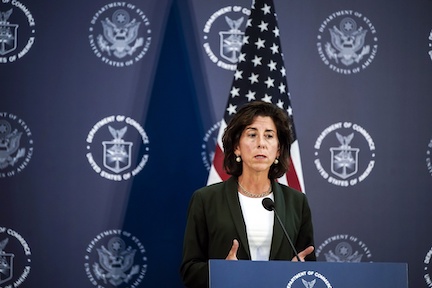
The US wants to help the Philippines double its semiconductor facilities, to lessen the geographic concentration of the global chip supply chain, Commerce Secretary Gina Raimondo said in a business forum in Manila on Tuesday.
The comments came in the wake of a Raimondo-led trade mission announcing over $1 billion in investments by US companies in the Philippines. The commerce chief, much like US Secretary of State Antony Blinken, has sought to encourage nations in Southeast Asia to deepen their investment in chipmaking and related industries, at a time when much of that business still happens in Taiwan, China and South Korea.
“US companies have realized that our chip supply chain is way too concentrated in just a few countries in the world,” Raimondo said. “Forget about geopolitics, just at that level of concentration, you know the old adage don’t put all your eggs in one basket. Why do we allow ourselves to be buying so many of our chips from one or two countries? That’s why we need to diversify.”
The Biden administration has sought to reduce the US’s reliance on just a few Asian nations for much of its chip supply, while at the same time adding sanctions to curb the advancement of China’s technological capabilities as tensions over Taiwan intensify.
The self-governing island that China claims as its territory — and which is home to giant Taiwan Semiconductor Manufacturing Co. — produces a lion’s share of the world’s most advanced semiconductors together with South Korea, while mainland China is a significant supplier of more mature, so-called legacy chips.
Electronics manufacturers and chipmakers including TSMC have sought to diversify their operations to regions including North America, India and Southeast Asia. The Philippines has 13 semiconductor assembly, testing and packaging facilities and Raimondo said “let’s double it.”
She did not offer any specifics on how the US may assist in that, other than to say it would be an attractive destination for US corporate customers. The Southeast Asian nation is rich on critical minerals, she added, and businesses are looking internationally to make their supply chain more resilient.
“There’s a moment right now in supply chain for your country, for this whole region,” Raimondo told Philippine executives. “I believe you are on top of the list.”
Bloomberg
© Bloomberg
The author’s opinion are not necessarily the opinions of the American Journal of Transportation (AJOT).
Similar Stories
“K” LINE to support relief efforts following earthquake off the Coast of Mindanao
The earthquake that struck off the coast of Mindanao, the Philippines, on June 8 caused severe damage in a number of regions.
View Article
Bab el-Mandeb: a second ‘chokepoint’ for global trade?
View Article
USMCA enters a new era: What the next 10 years mean for U.S. Importers
View Article
Transportation Consumer Price Index – June 2026
View ArticleSogese H2 Outlook: Suez return could unleash capacity and trigger fresh port congestion
Container freight rates have continued to climb into July.
View Article
Key European shipping corridor hit by river and rail freight ‘double whammy’
View ArticleGet the most up-to-date trending news!
SubscribeIndustry updates and weekly newsletter direct to your inbox!
Follow us on social media:


