
Upstream spending, cut by $285 billion in two years, will struggle to recover to pre-pandemic levels
May 12, 2021The toll of the Covid-19 pandemic on upstream investments in the first two years of the downturn is estimated at a whopping $285 billion, and although spending will slowly start to rise from 2022, it will not reach pre-crisis levels in the coming period, according to a Rystad Energy report. The shale sector has been the most affected, with conventional exploration and investments in mature assets suffering the least thus far.
In February 2020, before Covid-19 started impacting the global energy system, Rystad Energy estimated global upstream investments for the year would end up at around $530 billion, almost at the same level as in 2019. Our forecast at the time suggested 2021 investments would remain in line with the previous year’s level.
However, as the Covid-19 pandemic triggered a collapse in oil prices during the early part of the second quarter last year, E&P companies slashed investment budgets to protect cash flow. This spending trend was not reversed in 2021, when prices rose. Compared to pre-pandemic estimates for 2020 and 2021, we observe that spending fell by around $145 billion last year and will end up losing $140 billion by the end of this year. This implies Covid-19 removed 27% of planned investments.
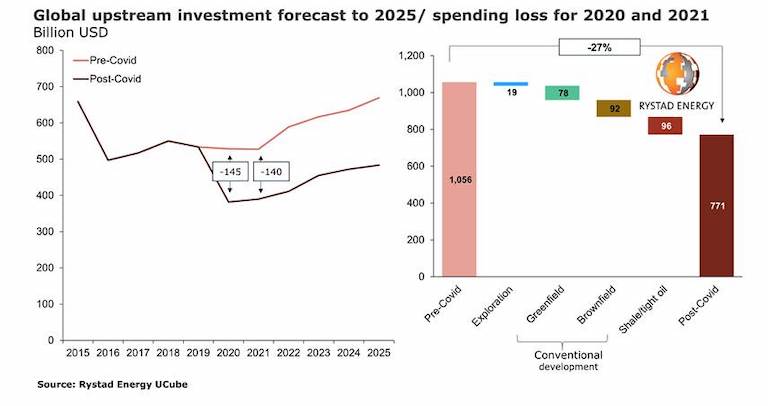
Upstream spending was limited to $382 billion in 2020 and is forecast to marginally grow to $390 billion this year. Rystad Energy expects the effect of the pandemic to be a lasting one as – even though spending will start growing from 2022 – it will not return to the pre-pandemic level of $530 billion. Growth will be limited and investments will only inch up annually, rising to just over $480 billion in 2025, when this report’s forecast ends.
Over the two-year period between 2020 and 2021, shale/tight oil investments are the ones most affected in both absolute and percentage terms, losing $96 billion of the previously expected spending, or 39% for the sector. Exploration spending is expected to drop by $19 billion, or 22%, compared to what was previously forecast. Greenfield investment in new conventional projects will suffer a $78 billion loss, or 28%, while brownfield investment in existing such projects will fall by $92 billion, or 20%.
“Since shale/tight oil is both the segment with the highest decline in activity and the supply source in greatest need of continuous reinvestment to keep production growing, the immediate impact on output from this sector has been significant,” says Espen Erlingsen, head of upstream research at Rystad Energy.
Similar Stories
CAMIMPEG confirmed as National Sponsor of Venezuela Energy Week 2026
CAMIMPEG has been confirmed as a National Sponsor of Venezuela Energy Week, taking place from October 26–29, 2026, in Caracas.
View ArticleHow the US-Iran scenarios shape Brent prices - Rystad Energy’s Oil Market Update
The oil market is shifting rapidly away from the simple question of whether the Strait of Hormuz reopens.
View Article
Port of Long Beach, MARAD sign first-of-its-kind partnership agreement on nuclear energy in maritime
View Article
DOT and Port of Long Beach sign agreement to test nuclear-powered vessels
View ArticleSPIRO publishes its first Sustainability Report
SPIRO published its inaugural Sustainability Report.
View Article
Latest Bureau Veritas approvals strengthen confidence in Anemoi Rotor Sail technology
View ArticleGet the most up-to-date trending news!
SubscribeIndustry updates and weekly newsletter direct to your inbox!
Follow us on social media:


