
UN sees ‘unprecedented challenges’ from canal crises and war

by Bloomberg Feb 22, 2024
Crises in the Suez and Panama Canals, along with war in the Black Sea region, are upending supply chains and contributing to greenhouse gas emissions, according to a United Nations report.
Transit through the canals — vital arteries for world trade — has slumped as drought plagues the Panama waterway and Houthi militant attacks discourage traffic through Suez and the Red Sea. Meanwhile, Russia’s war in Ukraine has altered key Black Sea trade routes for oil and grain.
The combined effect: longer shipping journeys, higher costs and more emissions, the UN Conference on Trade and Development said in its study. The events “signal unprecedented challenges for global trade affecting millions of people in every region,” it added.
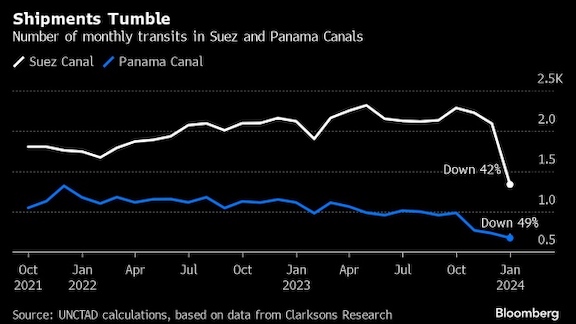
Ships are responsible for 80% of the global movement of goods, according to the agency. While freight is typically only a small component of the overall cost of products, major disruptions have the potential to drive energy prices higher and push up food costs.
Transit through Suez Canal has fallen by 42% from its peak last May, and container tonnage slumped by 82% by the first half of February as vessels avoid violence in the Red Sea region, UNCTAD said. Crossings through the Panama Canal — where the US is the largest client — have almost halved from their highest point.
Many vessels are taking lengthy diversions in response. An oil tanker sailing from Saudi Arabia to the Netherlands increases its journey length by almost 75% sailing around Africa’s Cape of Good Hope, rather than traveling through Suez, according to the report.
Container ship speeds have increased since the Houthi attacks began, resulting in more fuel use and pollution. A round-trip from Singapore to northern Europe — via the Cape rather than Suez — could result in a more than 70% jump in greenhouse gas emissions, UNCTAD said.
Container shipping rates have soared — though not as much as they did during the Covid pandemic — which can drive up inflation. About “half of the increase in food prices observed in 2022 was due to higher transport costs, which was a combination of higher distances and higher freight rates,” the agency estimated.
Bloomberg
© Bloomberg
The author’s opinion are not necessarily the opinions of the American Journal of Transportation (AJOT).
Similar Stories

EUKOR, SIPG Energy, and World Fuel complete first green methanol bunkering of new Shaper Class car carrier at Port of Shanghai
View Article
Latest Bureau Veritas approvals strengthen confidence in Anemoi Rotor Sail technology
View ArticleCrewmembers of MOL Group managed LNG vessel earn IMO commendation for 2025 rescue operation
Mitsui O.S.K. Lines, Ltd. today announced that crewmembers of the LNG carrier LNG SATURN, managed by its group company MOL Global Ship Management Pte. Ltd., have received a Letter of…
View Article[Freightos Weekly Update] Ocean rates ease on early peak season cooling and capacity additions
The US-Iran conflict may be expanding to the Red Sea as the Houthis announced the Bab el Mandeb Strait is closed to Saudi-linked ships.
View ArticleThe new great game of corridors will be decided in Haifa
The Hormuz blockade has opened the era of corridor geopolitics: whoever draws the route commands the trade. I
View Article
TA Services’ Steel Transportation Index estimates only 1.4% of U.S. carriers are qualified to handle Specialized steel freight
View ArticleGet the most up-to-date trending news!
SubscribeIndustry updates and weekly newsletter direct to your inbox!
Follow us on social media:


