
U.S. large-scale battery storage power capacity increased 35% in 2020
Aug 16, 2021The United States has continued a trend of significant growth in large-scale battery capacity, and U.S. battery power capacity reached 1,650 megawatts (MW) at the end of 2020. According to EIA’s report, Battery Storage in the United States: An Update on Market Trends, U.S. battery power capacity grew by 35% in 2020 and has tripled in the last five years.
EIA expects the trend to continue; utilities have reported plans to install over 10,000 MW of additional large-scale battery power capacity from 2021 through 2023.
“Growth in U.S. battery systems is critical as the United States faces new hurdles to reliable electricity delivery,” said EIA Acting Administrator Steve Nalley. “Energy stored in batteries can react to second-to-second fluctuations in the electric grid, protecting grid power quality and improving the grid’s efficiency.”
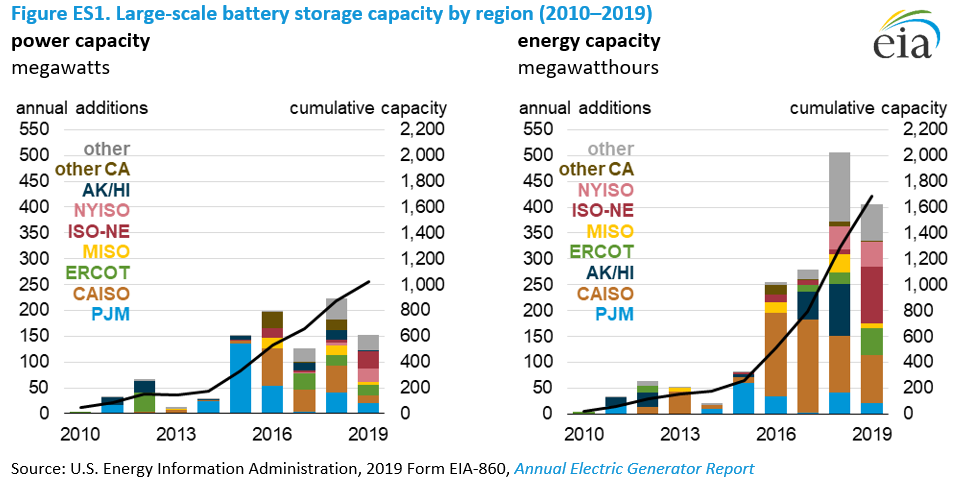
Much of the recent increase in new storage capacity comes from battery energy systems co-located with or connected to solar projects.
“Battery systems can help store electricity generated from solar or other renewables so that electricity is available at times when demand is peaking but generation from renewables is low,” Nalley said.
Five states account for more than 70% of U.S. battery storage power capacity as of December 2020. California has the largest share at 31% (or 506 MW) of the U.S. total. Texas, Illinois, Massachusetts, and Hawaii each have more than 50 MW of power capacity.
More than 400 MW of small-scale total battery storage power capacity also existed in the United States as of 2019, with California accounting for 83% of the capacity. Small-scale batteries have a nameplate power capacity of 1 MW or less.
Power capacity measures the maximum amount of power a battery system can discharge in an instant. Large-scale batteries can also be measured by energy capacity—the amount of energy a battery system can store. Large-scale U.S. battery system energy capacity also continued to increase, reaching 1,688 megawatthours at the end of 2019, a 30% increase from 2018.
The entire report is available on the EIA website.
Similar Stories

CN delivers on commitments with strong second quarter results
View ArticleCAMIMPEG confirmed as National Sponsor of Venezuela Energy Week 2026
CAMIMPEG has been confirmed as a National Sponsor of Venezuela Energy Week, taking place from October 26–29, 2026, in Caracas.
View ArticleHow the US-Iran scenarios shape Brent prices - Rystad Energy’s Oil Market Update
The oil market is shifting rapidly away from the simple question of whether the Strait of Hormuz reopens.
View Article
Port of Long Beach, MARAD sign first-of-its-kind partnership agreement on nuclear energy in maritime
View Article
DOT and Port of Long Beach sign agreement to test nuclear-powered vessels
View ArticleSPIRO publishes its first Sustainability Report
SPIRO published its inaugural Sustainability Report.
View ArticleGet the most up-to-date trending news!
SubscribeIndustry updates and weekly newsletter direct to your inbox!
Follow us on social media:


