
Rising US jet fuel refinery production contributes to high jet fuel inventories
Aug 04, 2021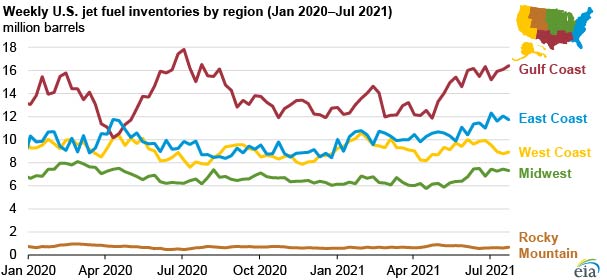
Rising U.S. air travel since the beginning of 2021 has contributed to increased demand for kerosene-type jet fuel in the United States. However, increased production of jet fuel has outpaced the higher demand, leading to higher-than-average jet fuel inventory levels.
Strong demand for petroleum products produced along with jet fuel, particularly gasoline and diesel, has encouraged refineries to process more crude oil to produce those high-demand products. Higher refinery runs have also resulted in increased jet fuel production. Since the first week of May (ending May 7, 2021), U.S. refinery runs have increased by nearly 6% (855,000 barrels per day), and refinery jet fuel production has increased by nearly 8% (102,000 barrels per day).
Although demand for jet fuel has grown from last year, current demand remains below the pre-pandemic five-year (2015–2019) average. We often use product supplied to measure jet fuel demand; product supplied reflects withdrawals of jet fuel from the primary supply chain rather than actual consumption. As of July 23, jet fuel product supplied was 14.8% lower than the pre-pandemic five-year average.
Increased jet fuel production and lower product supplied have contributed to rising inventories. As of July 23, the combined total U.S. jet fuel inventory was 9.9% higher than the five-year (2016–2020) combined average. In addition, on July 23, the combined total gasoline inventory was down 0.6%, and the combined total distillate fuel oil inventory was 6.8% below the five-year combined average. Along with increased production, relatively less jet fuel has been withdrawn from inventory since May 2021, which has contributed to increased jet fuel inventory.
The higher-than-average inventories vary, depending on the region. Jet fuel inventory levels in the Rocky Mountain region (PADD 4) and the West Coast region (PADD 5) have been decreasing and are near their previous five-year averages. Inventory levels in the East Coast region (PADD 1), Midwest region (PADD 2), and Gulf Coast region (PADD 3) have been increasing and are near or above their five-year highs.
Recent news articles report that transportation constraints are limiting the amount of jet fuel going from primary inventories to airports and other points of consumption in the western regions (the Rocky Mountains and West Coast). These constraints include limited pipeline or trucking capacity and restrictions on the volume of jet fuel that can be moved from the terminal to consumers, particularly those at more remote destinations. These constraints would also have some, although more limited, effect on the amount of jet fuel product supplied.
Similar Stories
CAMIMPEG confirmed as National Sponsor of Venezuela Energy Week 2026
CAMIMPEG has been confirmed as a National Sponsor of Venezuela Energy Week, taking place from October 26–29, 2026, in Caracas.
View ArticleHow the US-Iran scenarios shape Brent prices - Rystad Energy’s Oil Market Update
The oil market is shifting rapidly away from the simple question of whether the Strait of Hormuz reopens.
View Article
Port of Long Beach, MARAD sign first-of-its-kind partnership agreement on nuclear energy in maritime
View Article
DOT and Port of Long Beach sign agreement to test nuclear-powered vessels
View ArticleSPIRO publishes its first Sustainability Report
SPIRO published its inaugural Sustainability Report.
View Article
Latest Bureau Veritas approvals strengthen confidence in Anemoi Rotor Sail technology
View ArticleGet the most up-to-date trending news!
SubscribeIndustry updates and weekly newsletter direct to your inbox!
Follow us on social media:


