
Impact of Red Sea crisis on ocean freight shipping is more rapid than Covid-19 as tensions run high across the industry
Jan 30, 2024The Red Sea crisis has seen ocean freight rates increase faster than the early months of the Covid-19 pandemic as swathes of shippers are told some of their contracts will not be honored.
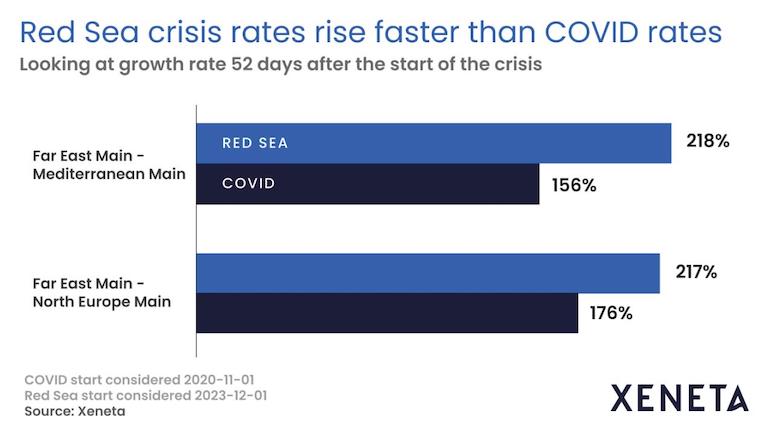
Xeneta, the leading ocean freight rate benchmarking and intelligence platform, has released data which reveals shipping costs on key trades from the Far East to Europe spiked more than 200% in the first 52 days of the Red Sea crisis.
This outpaces the increase in rates seen during the first 52 days of the pandemic.
Emily Stausbøll, Xeneta Market Analyst, said: “Rates have not hit anywhere near the levels we saw during Covid-19, but the sudden nature of the Red Sea crisis has seen a more rapid increase in rates, which is arguably creating even more disruption than during the early months of the pandemic.”
The impact of the Red Sea crisis, while more immediate, is not expected to be as prolonged as the pandemic – and shippers are becoming increasingly impatient and suspicious of carriers seeking to keep rates elevated for as long as possible.
This is backed by a poll of hundreds of Xeneta customers, which revealed almost two thirds of shippers have been told their minimum quantity commitments (MQCs) are not being honored under existing contract agreements, with carriers pushing them onto the freight all kinds (FAK) market and higher rates.
Peter Sand: Xeneta Chief Analyst, said: “Everyone is accusing everyone at the moment, which is normal during situations when there is so much uncertainty in the market.
“Ocean freight carriers did not invent this crisis and it takes time for them to put in new shipping networks to deal with the disruption caused by diverting away from the Suez Canal.
“However, you can also see this from the shippers’ perspective who may view the rate increases as carriers acting opportunistically to maximise the money they can make.”
With the market expected to peak during February, it remains to be seen how long shippers’ patience will last.
Stausbøll added: “It is inevitable that rates will come down once carriers are able to deal with the capacity crunch in the Far East resulting from ships being delayed returning from Europe via the Cape of Good Hope.
“At the moment shippers may accept the carriers’ argument that it takes time to react to such an unexpected and sudden crisis, but that will only last so long and we may see rates begin to flatten or decline sooner than many anticipated.”
Peter Sand and Emily Stausbøll are hosting a Xeneta Crisis in the Red Sea live webinar today, Tuesday, at 16:00 CET. They will provide the latest analysis on the crisis, including the spike in rates, surcharges, capacity crunches in the Far East and long term rates in 2024.
Similar Stories

UK ETS: Expansion into the maritime sector from 1 July 2026
View Article
CMA CGM | FAK Rates - North West India, South East India, Sri Lanka & Pakistan to North Europe, the Mediterranean & North Africa
View Article
Hormuz traffic falls 59% as renewed escalation drives vessel avoidance
View Article
CMA CGM | PSS UPDATE- From North Europe to the Middle East and Red Sea
View Article
DNV Type Approval Design Certificate accelerates deployment of Econowind VentoFoils
View Article
Two new gas carriers select Wärtsilä 25 Ammonia engine to support environmental compliance
View ArticleGet the most up-to-date trending news!
SubscribeIndustry updates and weekly newsletter direct to your inbox!
Follow us on social media:


