Global trade set to hit record $33 trillion by year-end
Dec 06, 2024
World trade is on track to hit a record $33 trillion in 2024, but risks of expanded trade wars and ongoing geopolitical challenges cast uncertainty over the outlook for 2025.
- Global trade is poised to hit an all-time high of nearly $33 trillion in 2024, with a $1 trillion increase largely driven by a 7% rise in services trade.
- Developing economies face slower trade growth, but high-growth sectors like information and communication technology (ICT) and apparel offer opportunities for diversification and resilience.
- Stable global growth and easing inflation create a window for developing economies to strengthen their trade position amid rising geopolitical uncertainties.
Global trade is set to reach a record $33 trillion in 2024, according to the latest Global Trade Update published by UN Trade and Development (UNCTAD) on 5 December.
This $1 trillion increase, reflecting 3.3% annual growth, highlights resilience in global trade despite persistent challenges.
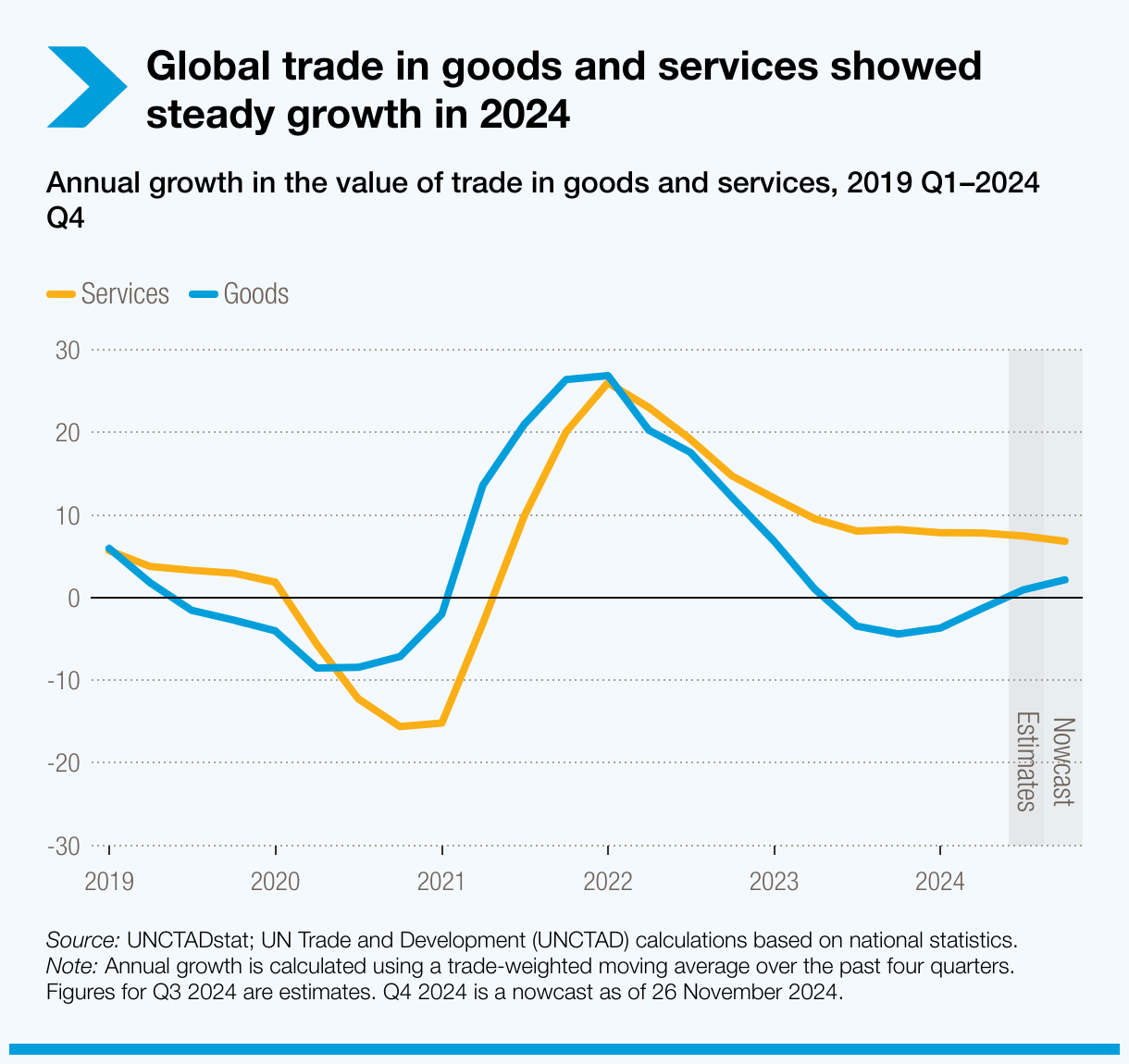
Robust growth in services trade, up 7% for the year, accounted for half of the expansion, while goods trade rose 2% but remained below its 2022 peak.

Global trade in goods and services showed steady growth in 2024
Annual growth in the value of trade in goods and services, 2019 Q1–2024 Q4
ServicesGoods201920202021202220232024-30-20-100102030Goods2023 Q16.8Goods2023 Q16.8EstimatesNowcastSource: UNCTADstat; UN Trade and Development (UNCTAD) calculations based on national statistics.Note: Annual growth is calculated using a trade-weighted moving average over the past four quarters. Figures for Q3 2024 are estimates. Q4 2024 is a nowcast as of 26 November 2024.Get the dataDownload imageOpportunities amidst uncertainty
Developing economies, traditionally strong drivers of global trade, faced headwinds in 2024, with imports contracting 1% and South-South trade falling by the same margin in the third quarter.
In contrast, developed economies led Q3 growth, with stable demand driving a 3% rise in imports and 2% in exports.
Despite these challenges, opportunities remain for developing economies to capitalize on high-growth sectors.
ICT and apparel trade surged, with increases of 13% and 14%, respectively, in the third quarter 2024. This growth underscores the potential for diversification and entry into value-added industries.
Stable global growth forecasts and easing inflation also present a chance to build resilience in 2025.
Sectoral pressures and growth prospects
While ICT and apparel showed strong momentum, traditional sectors critical to developing economies faced declines.
Energy trade fell 2% for the quarter and 7% for the year, while metals trade contracted by 3% both quarterly and annually.
Automotive trade dropped 3% in Q3 but is expected to end the year with modest 4% growth.
A call for strategic action
UNCTAD urges developing economies to adopt targeted policies that enhance trade diversification and invest in high-value sectors to mitigate risks.
The organization underscores that trade is a cornerstone of sustainable development. To capitalize on opportunities in 2025, developing economies require coordinated support to navigate uncertainty, reduce dependencies and strengthen global market links.
Similar Stories

Asian nations are building new trading zones to deflect the Trump tariff impact
View Article
Tighter supply and higher prices reshape Pacific Rim softwood markets
View Article
WCAworld launches emergency appeal to support earthquake relief efforts in Venezuela
View Article
U.S. international trade in goods and services, May 2026
View ArticleLiege will see global e-commerce leaders gather under one roof
The EU Cross-Border E-commerce Forum (EU CBEC) 2026 is celebrating having passed the 1,000-mark in registered attendees for the first time ever.
View Article
Indonesia’s Ministry of Forestry, WCS Indonesia and CMA CGM strengthen partnership to combat illegal wildlife trade
View ArticleGet the most up-to-date trending news!
SubscribeIndustry updates and weekly newsletter direct to your inbox!
Follow us on social media: