
Global supply chains set for overhaul next year, HSBC poll shows

by Bloomberg Nov 10, 2022
More than 40% of corporate decision-makers see an urgent need to overhaul their supply chains in 2023, with inflation, higher interest rates and weaker global trade acting as some of the stiffest economic headwinds, a new survey showed.
Just 11% of respondents in the HSBC Holdings Plc survey said transforming their supply chain wasn’t a priority next year, but 42% plan to do so and almost 47% see it as a priority at some stage in the future. Conducted by the research firm Toluna, the poll covered 2,170 executives at medium-size companies in 14 countries from Sept. 28 to Oct. 24, according to the London-based bank.
The survey also showed concerns were broader than supply chains, with 51% of respondents saying their expect the environment for international trade to be harder next year. That lines up with the latest forecasts from the World Trade Organization for cross-border commerce to grow just 1% next year, after a projected 3.5% increase this year.
Asked about the biggest impediments to their business next year, 38% cited inflation, 32% pointed to higher interest rates and 27% said an uncertain political environment, the poll showed.
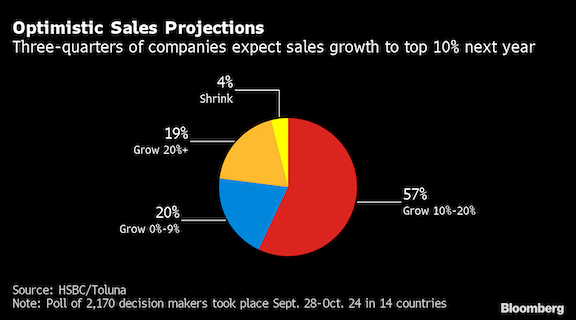
Overall, though, there was plenty of optimism about revenue prospects for the year ahead, according to the survey. More than three-quarters expect sales growth to exceed 10% next year, with 19% of those respondents expecting revenue to increase by more than 20%.
“Businesses are operating in an increasingly complex global economic landscape, navigating a wide range of challenges,” Barry O’Byrne, chief executive of HSBC’s global commercial banking unit, said in a statement. “Despite this, there is a strong sense of global resilience and ambition amongst mid-size businesses.”
Here’s a breakdown for several countries where supply chains and global trade are especially key:
India
Indian business leaders are some of the most optimistic about international trade in 2023, with 45% expecting it will be easier, compared with 28% globally. Seven in 10 plan to enter at least one new foreign market, and 58% will focus on making their supply chain more secure.
Australia
Almost half will focus on making their supply chain more secure, but 18% are concerned there is a lack of quality suppliers and goods, according to the survey.
Malaysia
Some 65% say they will focus on making their supply chain more sustainable in 2023, but 29% were concerned about a lack of quality suppliers and goods to support a sustainable supply chain.
Indonesia
Similarly, some 80% of respondents will focus on making their supply chain more sustainable, but at the same time 28% are concerned about a lack of quality suppliers and goods.
Bloomberg
© Bloomberg
The author’s opinion are not necessarily the opinions of the American Journal of Transportation (AJOT).
Similar Stories

Key European shipping corridor hit by river and rail freight ‘double whammy’
View Article
DHL Group deploys Disaster Response Team to Venezuela
View Article
Asian nations are building new trading zones to deflect the Trump tariff impact
View Article
Tighter supply and higher prices reshape Pacific Rim softwood markets
View Article
WCAworld launches emergency appeal to support earthquake relief efforts in Venezuela
View Article
U.S. international trade in goods and services, May 2026
View ArticleGet the most up-to-date trending news!
SubscribeIndustry updates and weekly newsletter direct to your inbox!
Follow us on social media:


