
FTR’s Trucking Conditions Index for October falls due to a surge in diesel prices
Dec 13, 2021\FTR’s Trucking Conditions Index (TCI) measure for October fell to a reading of 7.75 – the weakest reading since July 2020 – because of a surge in diesel prices. Had fuel prices been a neutral factor, the change in the index from September’s 11.79 reading would have been negligible. Freight rates remain the largest positive factor, although they were modestly less positive in October. However, freight volume and utilization were stronger positive factors than they had been in September. Fuel costs have now stabilized, and the TCI outlook is for solidly positive readings well into 2022.
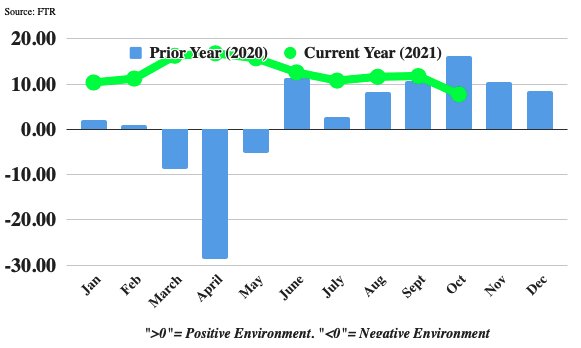
Details of the October TCI are found in the December 2021 issue of FTR’s Trucking Update, published November 30. The December edition includes a discussion of why the nearly complete recovery of payroll jobs in trucking does not describe what is happening with truckload drivers. Beyond the TCI and additional commentary, the Trucking Update includes data and analysis on load volumes, the capacity environment, rates, and the economy.
Avery Vise, FTR’s vice president of trucking, commented, “October was an outlier due to the brief surge in diesel prices, but conditions in 2022 are unlikely to be quite as robust for carriers as they are today. We expect slower growth in freight volume and a slight easing of capacity utilization resulting in a gradual stabilization of freight rates at an elevated level. Even so, market conditions should favor carriers at least into 2023. Potential downside risks for this outlook include further gains in driver capacity and a sharply reduced consumer spending due to inflation and a loss of stimulus. However, the pent-up demand in the automotive sector could offset any softening due to those factors.”
The TCI tracks the changes representing five major conditions in the U.S. truck market. These conditions are: freight volumes, freight rates, fleet capacity, fuel price, and financing. The individual metrics are combined into a single index indicating the industry’s overall health. A positive score represents good, optimistic conditions. Conversely, a negative score represents bad, pessimistic conditions. Readings near zero are consistent with a neutral operating environment, and double-digit readings in either direction suggest significant operating changes are likely.
Similar Stories

AAR reports rail traffic for the week ending July 18, 2026
View Article
Schneider receives Certified Cold Carrier designation, demonstrating industry leadership in dedicated refrigerated shipping
View ArticleFleetio customers reject $41.6M in unnecessary repair costs as AI-powered maintenance scales in first half of 2026
Purpose-built for maintenance, Fleetio's embedded AI delivered measurable cost control across thousands of fleets
View Article
GoAL executive set to join Louisiana Committee reviewing oversized and overweight permitting
View ArticleTransportation Construction Coalition: Federal funding helps ease congestion and drive economic growth in Louisiana
Today, the Transportation Construction Coalition (TCC), the unified voice of America’s transportation construction industry, released a new case study highlighting how federal investment is reducing congestion and driving economic growth…
View Article
Davies Turner expands German road freight services with new Hanover groupage service
View ArticleGet the most up-to-date trending news!
SubscribeIndustry updates and weekly newsletter direct to your inbox!
Follow us on social media:


