
EIA publishes a ratio of revenues-to-costs to explain power plant additions
Feb 23, 2021
A supplemental report to the U.S. Energy Information Administration’s (EIA) Annual Energy Outlook 2021 (AEO2021) describes how EIA uses a ratio of a power plant’s revenue to its cost (or value-cost ratio) as a simple metric to explain the economic competitiveness and, in turn, the types of power plants most likely to be built in EIA’s long-term model for the U.S. energy sector.
The average value-cost ratio for solar photovoltaic (PV) is estimated to be greater than one, which suggests power plant revenue will generally be greater than its costs through the projection period. The economic attractiveness of solar PV leads to more than 160 gigawatts (GW) of new capacity additions in the AEO2021 Reference case between 2023 and 2050. With an average value-cost ratio slightly less than one, nearly 132 GW of new natural gas-fired combined-cycle capacity is added during the same period because some regions still have higher-than-average value-cost ratios.
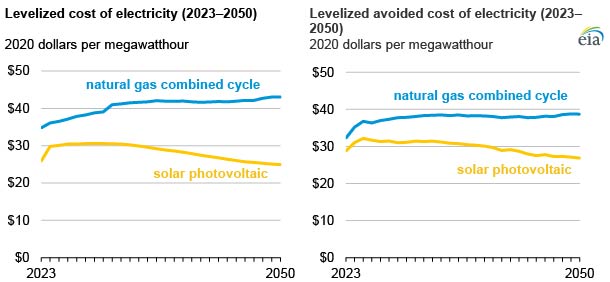
The cost metric, or levelized cost of electricity (LCOE), includes installed capital costs and operating expenses of a power plant, converted to an equal annual quantity over the plant’s assumed cost recovery period. The LCOE for natural gas-fired combined-cycle plants is higher than solar PV, and it increases over time because of the rising natural gas prices that, in turn, increase plant operating costs. The LCOE for solar PV increases in the near term because the current solar Investment Tax Credit is set to decline from 30% to 10% of the initial capital cost by 2024, but the LCOE is expected to trend downward over the long term as solar PV capital costs continue to decline.
The value metric, or levelized avoided cost of electricity (LACE), is an estimate of a plant’s potential revenues from the sales of electricity generated from displacing other more expensive generation. As with LCOE, these revenues are converted to an equal annual amount over the plant’s assumed cost recovery period. The LACE for solar PV generally declines over time as the daylight power market becomes saturated with generation from solar PV plants, which have no fuel and operating costs. LACE for combined-cycle plants is higher because it can generate during the hours when power prices are higher.
Similar Stories

Before 2026 diesel spike: US zero emission trucks deployments were rising
View Article
bound4blue eases eSAIL® adoption with ABS review of Pwind calculation methodology
View Article
A mobile green hydrogen refueling station enables the immediate deployment of a hydrogen bus fleet in Northern Germany
View Article
U.S. refinery capacity has dropped from 2025 to 2026
View Article
Svanehoj to supply LTD gauging systems for an LNGC-to-FSU conversion
View Article
TGP appoints Igor Muñiz as Chief Strategy Officer
View ArticleGet the most up-to-date trending news!
SubscribeIndustry updates and weekly newsletter direct to your inbox!
Follow us on social media:


