
EIA projects non-OECD Asia to become the largest importers of natural gas by 2050
Oct 20, 2021In our International Energy Outlook 2021 (IEO2021), we project that non-OECD countries in Asia will collectively become the largest importers of natural gas by 2050. In 2020, the countries of OECD Europe were collectively the largest importers of natural gas, followed by Japan and South Korea combined, and then non-OECD Asia, which includes China and India.
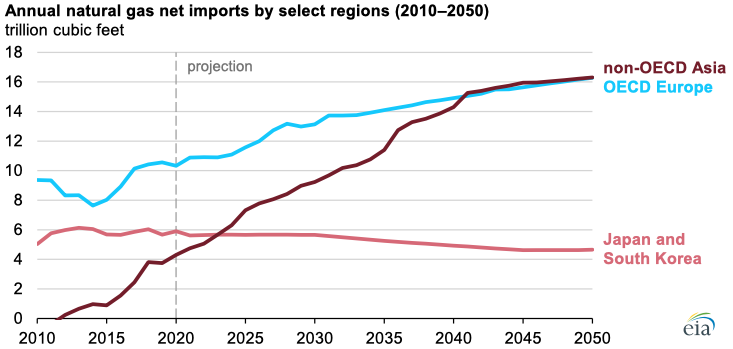
All of these groups of countries import natural gas because their consumption exceeds their domestic supply. We project that continued economic growth in non-OECD Asia, led primarily by China and India, will more than double net imports of natural gas into the region by 2050. To meet the natural gas needs of these growing economies, we project that global natural gas production will increase steadily along with exports from the three largest natural gas producers: the United States, Russia, and the Middle East.
In our IEO2021 Reference case, the United States, Russia, and the Middle East continue to expand natural gas production through 2050, and the United States remains the largest natural gas producer worldwide, producing almost 43 trillion cubic feet (Tcf) in 2050 compared with 34 Tcf in 2020. The United States, Russia, and the Middle East all have large proven reserves of both natural gas and oil as well as the processing and transportation infrastructure to support production increases. Liquefied natural gas (LNG) terminals and transportation vessels create an outlet for natural gas produced in the United States and the Middle East to reach markets in Asia and Europe.
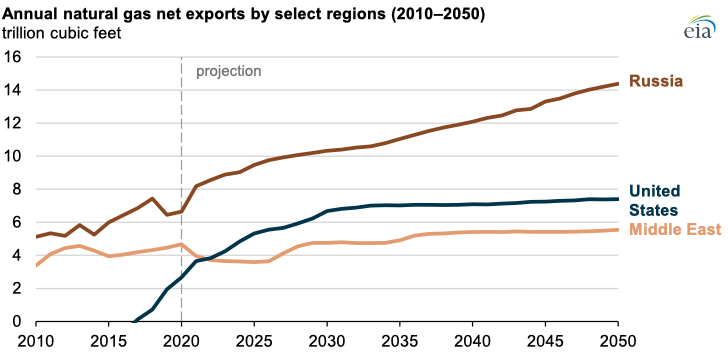
We project that Russia, in particular, will show the largest growth in net exports, more than doubling over the projection period to remain the largest net exporter of natural gas by 2050, at more than 14 Tcf. Close proximity to Europe and Asia will facilitate growth in Russia’s net natural gas exports through established pipeline infrastructure, potential future pipeline additions, and liquefied natural gas exports. During the next 10 years, we project that the United States will see its most rapid period of growth; net exports of U.S. natural gas nearly double as the United States expands its LNG infrastructure and produces natural gas at high volumes.
Principal contributors: Peter Colletti, Max Ober
Similar Stories

CN delivers on commitments with strong second quarter results
View ArticleCAMIMPEG confirmed as National Sponsor of Venezuela Energy Week 2026
CAMIMPEG has been confirmed as a National Sponsor of Venezuela Energy Week, taking place from October 26–29, 2026, in Caracas.
View ArticleHow the US-Iran scenarios shape Brent prices - Rystad Energy’s Oil Market Update
The oil market is shifting rapidly away from the simple question of whether the Strait of Hormuz reopens.
View Article
Port of Long Beach, MARAD sign first-of-its-kind partnership agreement on nuclear energy in maritime
View Article
DOT and Port of Long Beach sign agreement to test nuclear-powered vessels
View ArticleSPIRO publishes its first Sustainability Report
SPIRO published its inaugural Sustainability Report.
View ArticleGet the most up-to-date trending news!
SubscribeIndustry updates and weekly newsletter direct to your inbox!
Follow us on social media:


