
APM’s Los Angeles terminal is making the transition to zero emissions

by Stas Margaronis Nov 12, 2025
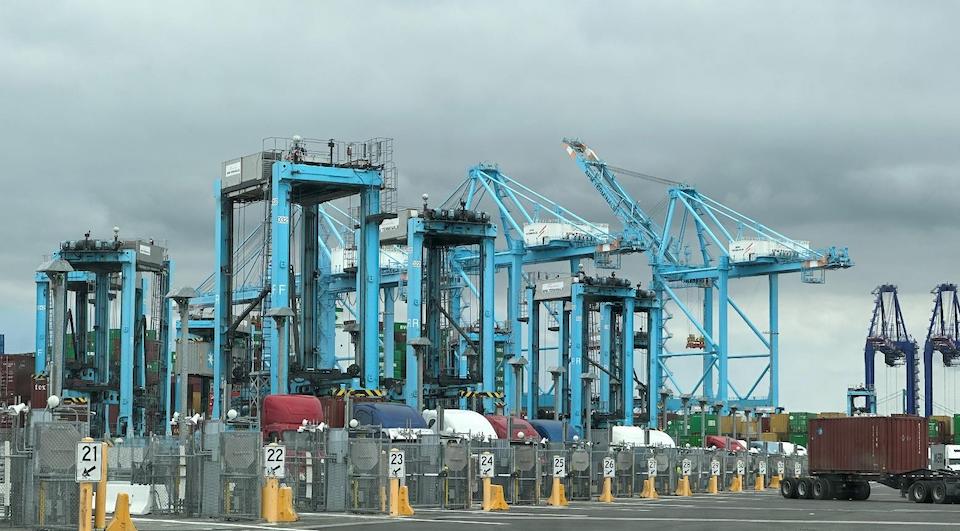
The APM Terminal at the Port of Los Angeles is making the transition away from fossil fuels cargo handling equipment, and over to zero emissions. One benefit is that the terminal has seen a reduction in turn times for trucks, going from 90 minutes to about 35 minutes, according to Jon Poelma, Managing Director, APM Terminals, Los Angeles.
In an interview with AJOT, during a tour of the container terminal, Poelma said:
“The automation started around 2019, and then shortly after that we started bringing in the hybrid straddle carriers which operate 60% on battery and 40% on renewable diesel … The transition will really start happening into next year, as part of the Clean Port and EPA grant that many of the terminals and LA and Long Beach have received. Each terminal is working with its respective port authority to move those purchases forward. And then we're also at the same time in the Port of Los Angeles, we are working with the Los Angeles Department of Water and Power (LADWP) to ensure that we get a consistent, reliable power into the terminal.”
The Power, a Challenge
The LADWP, a Long Angeles city agency, has had problems delivering power to container terminals at the Port of Los Angeles. It is in the process of upgrading its infrastructure at the Port of Los Angeles. “We have brownouts. Yeah. We've had quite a few brownouts this year, and we do meet periodically with LADWP all the way up to the CEO and they've committed that by 2030, we'll have the necessary electricity. So, we've done a number of studies to quantify how much electricity the terminal needs. So, I think we feel pretty confident about how much is needed. We just got to continue to get confidence through seeing detailed project plans that they can actually produce a consistent, reliable supply of power to the terminal.”
Poelma said APMT is now consuming about 7 megawatts of electricity and projects to increase to about 18 megawatts in terms of power generation for zero emissions. As a result, the investment by LADWP in new power delivery is critical.
One bright spot is that the redesign of the terminal to accommodate automated straddle carriers has improved truck traffic flow. The result is that dwell times for trucks in the terminal have declined from 90 minutes to about 35 minutes: “I would say that the new layout of the facility has helped to reduce turn times, and we're getting those turn times to around 35 minutes from in gate to out gate. And then a couple of years ago, we launched the green lane, which allows clean certified trucks to get into the terminal through an express lane.”
That reconfiguration included reducing the travel distance for trucks bringing in an import container and taking out an export container from 4 miles to around 2 miles: “We were in what was known as a conventional rubber tire gantry crane operation. And so then you're using diesel engines and these rubber tire gantry cranes, and the drivers were traversing through stacks or rows of containers rather than in single file as you saw today, where the traffic's only going one direction. So you don't have opposing traffic.”
There are 71 electric machines now operating at APMT’s Pier 400, representing about 15% of all equipment, with nearly 70 additional units on order that will bring the fleet to roughly 30% electric.
Currently, the terminal has an annual capacity of loading and unloading 3.17 million TEUs and can handle vessels of up to 20,000 TEUS.
Decision-Making Process
Ryan Lansden, Director, Sustainability, said that APMT worked with five manufacturers before deciding to deploy two manufacturers of electric-powered tractors in the terminals. “Terminal trucks, we've piloted five OEMs on terminal over the last two and a half years. And with those learnings, we've committed to two that we believe are well-positioned in a mature product that can go to upscale,” Lansden said.
Lansden added there are currently “a total of 51 charging stations from all the way down to a level two application that charges our light duty vehicles, which are pickup trucks and cars, all the way up to a level three pantograph automated charging solution of a 600 KW charger. So, 51 total chargers have been deployed. Of those 49 of them are manually plugged and unplugged operations. The two pantographs are automated charging solutions that charge the batteries on the automated straddle carriers.
As a result, the charging stations need to be concentrated so that expansion of LADWP power delivery can be concentrated in as few areas as possible to keep costs lower: “We're looking at ways that we can cluster those charging stations to a single charging point, or can we bring more of a dedicated charging area to minimize the impact of the infrastructure and space requirements.”
Equipment Bugs and Solutions
New equipment has come with defects that APMT has to work with the manufacturers to upgrade, Lansden said.
One example was “with the terminal tractors, we've had some situations where the battery pack disconnected from the power source. It was …a recall item that they identified … we had one of our terminal tractors stranded under the vessel operation that we had to tow it back. And then we had to bring in all 19 of the similar machines and had to do that retrofit work.”
In spite of many challenges, that include bugs with electric powered straddle carriers that still need to addressed, Poelma is hopeful that the terminal will meet the Ports of Los Angeles and Long Beach’s Clean Air Action Plan goal of all zero emission cargo handling equipment by 2030: “So, if LADWP and the Port of Los Angeles can get power to us then the technology is there. So, … if we have ambitions to get to zero emissions by 2030, that's still there. But we've got to work closely with LADWP and work out the bugs … Infrastructure is key they've got to get us the power to go from 7 MW to 18 MW, which is a large jump. So, upgrading transformers on site and installing the switching stations are key.”
Finally, Poelma said Maersk container ships that are serviced at APMT will soon be fueled with near-zero emission methanol rather than relying on green methanol fueling in China: “Yes. There are opportunities out there that we can't talk about, but methanol will be, will be produced, will be available in this market.”
Stas Margaronis
Similar Stories

One year later: HaiSea celebrates 100 successful LNG carrier escorts into Kitimat
View Article
Anchored by safety: Port of Hueneme holds maritime security and emergency response exercise
View Article
PhilaPort ranked Nation’s Most Productive Container Port for third consecutive year
View Article
PANYNJ April volume resumes steady pace after leading the nation in March
View Article
Yale Route Runner direct-store-delivery solution recognized as one of 2026’s most innovative products
View Article
Scylla Shipping sets course for a more sustainable future with battery systems from Corvus Energy
View ArticleGet the most up-to-date trending news!
SubscribeIndustry updates and weekly newsletter direct to your inbox!
Follow us on social media:


