
Utilities’ carbon-reduction goals will have little impact on U.S. CO2 emissions
Feb 04, 2022Executing several plans announced by U.S. power utilities to reduce carbon dioxide (CO2) emissions would have a minor effect on U.S. energy-related CO2 reductions, according to the analysis we published earlier this week. As part of the Annual Energy Outlook 2021 (AEO2021), we created a Corporate Goal case that incorporates assumptions based on carbon-reduction goals outlined in utilities' integrated resource plans and on the carbon-reduction goals stated in press releases and other utility plans.
We collected utility carbon-reduction goals through a comprehensive review of filed integrated resource plans and announced commitments from investor-owned utilities as of October 2020, when we finalized assumptions for the AEO2021.
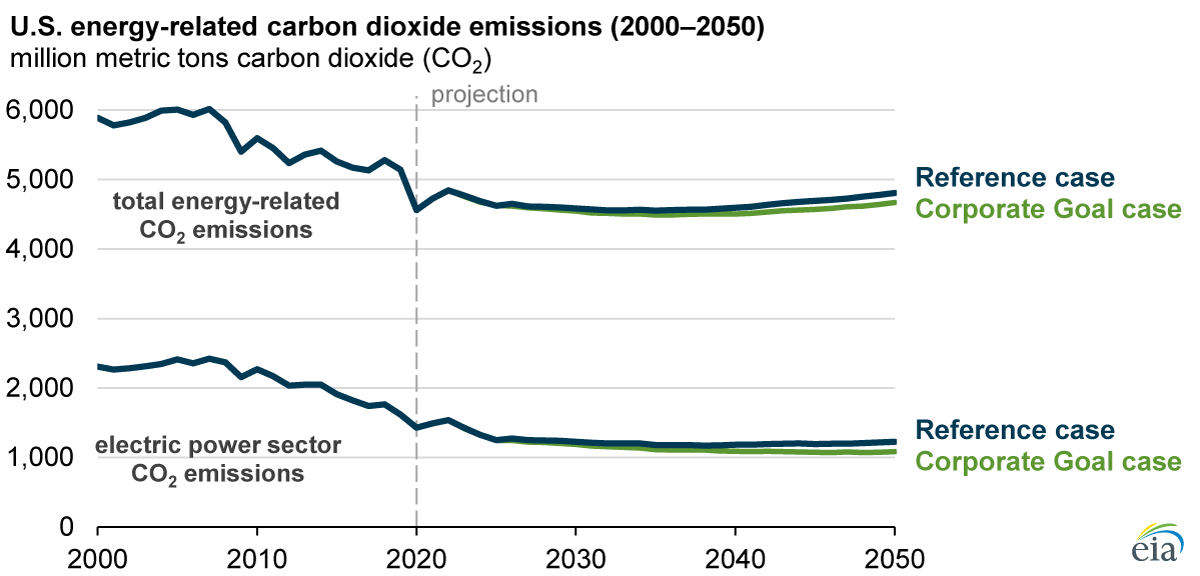
We project that CO2 emissions across the U.S. energy system would be 3% lower by 2050 under the Corporate Goal case compared with our Reference case. The Reference case includes assumptions based on current laws and regulations, and we use it as a baseline for policy or other side case analysis, such as this one.
Within the electric power sector, we project that U.S. CO2 emissions are 12% lower in the Corporate Goal case than in the Reference case. Meeting announced utility goals would lead to more electricity generation from carbon-neutral generation resources. In particular, fewer existing nuclear plants retire in the Corporate Goal case, which reduces the need for new capacity from renewable technologies.
This outcome occurs in part because our model identifies existing nuclear generation as being among the lowest-cost options for meeting clean energy or carbon-reduction goals. Existing nuclear plants typically have operation and maintenance costs that are less than the cost of building new low-carbon capacity.
The full report, Corporate Goal Case: Using the Annual Energy Outlook 2021, includes more information on these assumptions and their effects on the U.S. electricity generation mix and resulting CO2 emissions.
Principal contributor: Richard Bowers
Similar Stories

Port of Los Angeles’ Seroka report 1 million TEUs in June up 12%
View Article
Port of Antwerp-Bruges stands firm in challenging first half of 2026
View Article
Lloyd’s List Intelligence launches Maritime Intelligence Unit to help organizations navigate rising maritime risk
View Article
Port of Los Angeles records best June ever, tops 1 million container units
View Article
Petroleum markets responded to disruptions in the Middle East in the second quarter
View Article
Airport Cargo Community Systems deliver proven ROI and are accelerating air cargo digital transformation
View ArticleGet the most up-to-date trending news!
SubscribeIndustry updates and weekly newsletter direct to your inbox!
Follow us on social media:


