
US overtakes China as South Korea’s top export market

by Bloomberg Jan 02, 2024
South Korean exports to the US exceeded shipments to China for the first time in two decades last month, in a sign of shifting ties amid global tensions over economic security and tech supply chains.
South Korea sold $11.3 billion in goods to the US in December compared with $10.9 billion to China, the trade ministry said Monday. The switch in positions came as South Korea’s overall exports rose 5.1% from a year earlier — a third monthly increase after a yearlong slump.
The change in positions partly reflects China’s economic challenges, which led policymakers to come up with a series of stimulus measures last year. Still, one month’s data doesn’t offer conclusive proof of a conscious or enduring shift in trading patterns.
China remains South Korea’s biggest trading partner by a large margin given the scale of Seoul’s imports from the world’s second-largest economy.
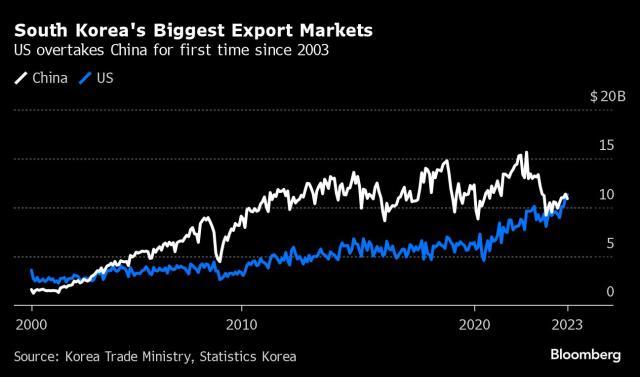
While exports to the US have increased from a year earlier for a fifth month, South Korea said shipments to China also continued to improve. Meanwhile, South Korea’s overall imports declined 10.8% from a year earlier, with a trade surplus widening to $4.5 billion.
The data come as the US looks to generate support for its agenda to reduce dependence on China in global supply chains and limit the country’s access to advanced semiconductor technology.
That has placed countries like South Korea and Japan in an awkward spot between their two biggest trading partners. Both Seoul and Tokyo are key military allies of Washington, another important dimension given Beijing’s increasing assertiveness in the Indo-Pacific and rising tensions in the region.
Under President Yoon Suk Yeol, South Korea has been forging stronger ties to the US. Yoon traveled to Washington last year with a plethora of Korean executives, where he pitched deeper ties with America in meetings with President Joe Biden and Congress.
South Korea and the US have a free-trade agreement which began in 2012, so Seoul benefits from US laws that increasingly restrict the use of batteries and other products made in countries including China.
China is also ramping up domestic production of goods as it moves up the value chain. One key area that China is focusing on is semiconductor and smartphone manufacturing, a development that has contributed to a slump in sales of goods made by Samsung Electronics Co. and other businesses.
Bloomberg
© Bloomberg
The author’s opinion are not necessarily the opinions of the American Journal of Transportation (AJOT).
Similar Stories

Transportation Consumer Price Index – June 2026
View ArticleSogese H2 Outlook: Suez return could unleash capacity and trigger fresh port congestion
Container freight rates have continued to climb into July.
View Article
Key European shipping corridor hit by river and rail freight ‘double whammy’
View Article
DHL Group deploys Disaster Response Team to Venezuela
View Article
Asian nations are building new trading zones to deflect the Trump tariff impact
View Article
Tighter supply and higher prices reshape Pacific Rim softwood markets
View ArticleGet the most up-to-date trending news!
SubscribeIndustry updates and weekly newsletter direct to your inbox!
Follow us on social media:


