
US natural gas consumption to decline through 2022, led by the electric power sector
Sep 10, 2021
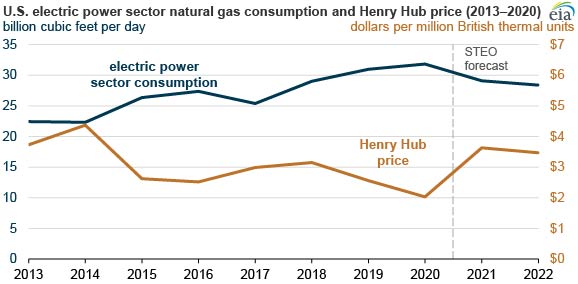
In EIA’s September Short-Term Energy Outlook, we expect U.S. consumption of natural gas to decline in 2021 and 2022 from 2020 levels. We forecast that consumption of natural gas will decline in all end-use sectors in the United States except in the industrial sector and for other non-sector-specific uses (lease and plant fuel, pipeline and distribution use, and vehicle use). The largest decline will occur in the electric power sector. We expect total U.S. consumption of natural gas to average 82.5 billion cubic feet per day (Bcf/d) in 2021, down 0.7 Bcf/d from 2020. We expect U.S. natural gas consumption in 2022 to increase slightly from 2021 as increasing consumption in the industrial sector offsets declining consumption in the electric power sector, but still remains lower than the 2020 level.
In the United States, natural gas prices influence natural gas consumption in the electric power sector. When natural gas prices are high, generators typically switch from natural gas to lower-cost coal as the source for power generation. Higher prices at Henry Hub, the U.S. natural gas benchmark, during the first half of 2021 resulted in less natural gas consumption in the electric power sector than during the first half of 2020. We expect the Henry Hub price to average $3.63 per million British thermal units (MMBtu) in 2021, or $1.60/MMBtu more than the 2020 average. Therefore, we expect 2.7 Bcf/d, or 8.3%, less consumption of natural gas in the U.S. electric power sector in 2021. We expect another small, 0.7 Bcf/d, decline in electric power sector consumption of natural gas in 2022 as forecast Henry Hub prices remain elevated at $3.47/MMBtu and as natural gas faces more competition from renewable sources of electricity generation.
We expect natural gas consumption in the U.S. industrial sector to increase in 2022 to 23.8 Bcf/d from an average of 23.2 Bcf/d in 2021. Natural gas consumed by the industrial sector is dependent on the level of industrial activity, which we measure in the STEO using a natural gas-weighted industrial consumption index. This index reflects the growth of manufacturing subsectors and their relative importance to U.S. natural gas consumption. We expect that the index will increase 5.8% in 2021 from 2020 levels and another 5.8% in 2022 from 2021 levels, reflecting continuing post-pandemic economic growth.
Similar Stories
CAMIMPEG confirmed as National Sponsor of Venezuela Energy Week 2026
CAMIMPEG has been confirmed as a National Sponsor of Venezuela Energy Week, taking place from October 26–29, 2026, in Caracas.
View ArticleHow the US-Iran scenarios shape Brent prices - Rystad Energy’s Oil Market Update
The oil market is shifting rapidly away from the simple question of whether the Strait of Hormuz reopens.
View Article
Port of Long Beach, MARAD sign first-of-its-kind partnership agreement on nuclear energy in maritime
View Article
DOT and Port of Long Beach sign agreement to test nuclear-powered vessels
View ArticleSPIRO publishes its first Sustainability Report
SPIRO published its inaugural Sustainability Report.
View Article
Latest Bureau Veritas approvals strengthen confidence in Anemoi Rotor Sail technology
View ArticleGet the most up-to-date trending news!
SubscribeIndustry updates and weekly newsletter direct to your inbox!
Follow us on social media:


