
U.S. wind generation sets new daily and hourly records at end of 2020
Feb 02, 2021In the final months of 2020, electricity generation from wind turbines in the United States set daily and hourly records. Hourly data collected in the U.S. Energy Information Administration’s (EIA) Hourly Electric Grid Monitor show an hourly record set late in the day on December 22 and a daily record set on the following day.
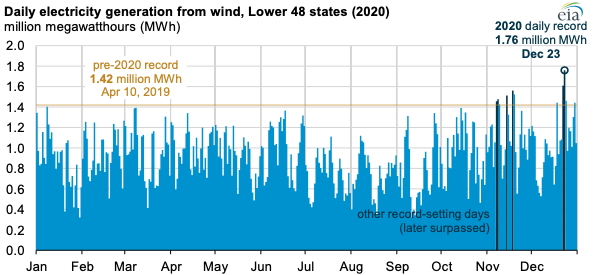
On April 10, 2019, daily electricity generation from wind turbines in the United States (excluding Alaska and Hawaii) reached a high of 1.42 million megawatthours (MWh). That record stood for a year and a half before it was surpassed on several days in November and December 2020. Wind electricity generation reached 1.76 million MWh on December 23, or about 17% of total electricity generation on that day. On average, EIA estimates that wind accounted for 9% of U.S. electricity generation in 2020.
Wind-powered electricity has increased in the United States as more wind turbines have been installed in recent years. Strong wind conditions in November and December, especially in the central United States, led to more output from wind turbines. Wind power surpassed hydropower as the predominant renewable electricity generation source in the United States on an annual basis in 2019. In its latest Short-Term Energy Outlook, EIA expects wind to exceed hydroelectricity in every month of 2021 and 2022.
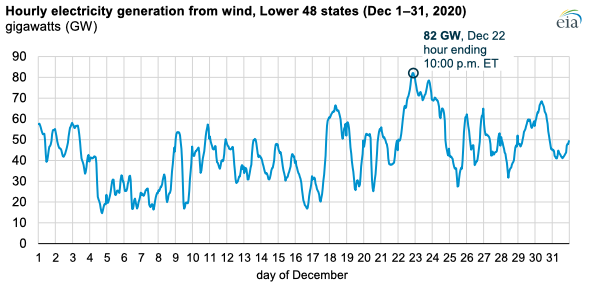
Hourly dispatch of wind resources also established new U.S. records in late 2020. On December 22, in the hour ending 10:00 p.m. Eastern Time (ET), 82.0 gigawatts (GW) of electricity sourced from wind was dispatched across the United States, much more than the previous hourly dispatch record of 73.4 GW set on the evening of November 18, 2020. Hourly U.S. wind output remains considerably variable, ranging from the high of 82.0 GW to a low of 14.6 GW during the 744 hours in December 2020. Wind output in the United States tends to be highest overnight and lowest during midday.
Project developers and grid operators plan to add another 12.2 GW of new wind capacity to the U.S. electric grid by the end of 2021. More than half of that planned capacity is in Texas and Oklahoma.
Principal contributor: Mark Morey
Similar Stories

U.S. airlines’ May 2026 aviation fuel cost up 3.0%, consumption up 3.5%, and fuel cost per gallon down 0.5% from April 2026
View Article
Clean energy on the front line at Heathrow Animal Reception Centre
View Article
Offshore operations: Why small improvements no longer cut it?
View Article
OOCL Wisdom completes first green methanol bunkering and commences maiden voyage at Qingdao Port
View Article
bound4blue eases eSAIL® adoption with ABS review of Pwind calculation methodology
View Article
A mobile green hydrogen refueling station enables the immediate deployment of a hydrogen bus fleet in Northern Germany
View ArticleGet the most up-to-date trending news!
SubscribeIndustry updates and weekly newsletter direct to your inbox!
Follow us on social media:


