
U.S. energy trade lowers the overall 2020 U.S. trade deficit for the first time on record
Sep 22, 2021In 2020, the U.S. net merchandise trade value of energy products—the value of petroleum, natural gas, coal, and electricity exports less the value of their imports—was a surplus of $27 billion. This amount marks the first time the value of U.S. energy exports exceeded imports since at least 1974, the earliest year in the U.S. Census Bureau’s trade value data.
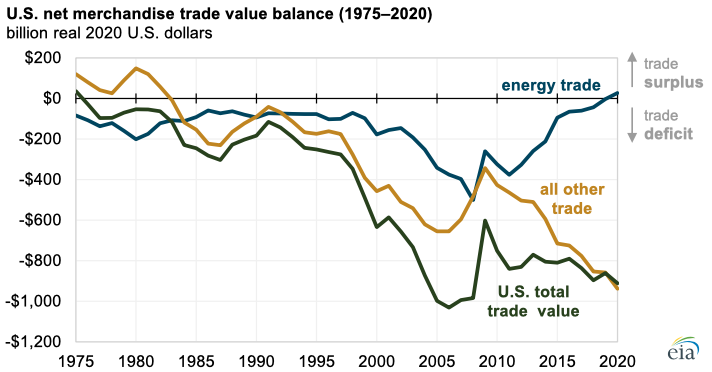
In 2020, the U.S. net merchandise trade value of non-energy goods (which compares the value of all U.S. exports to all imports) reached a record $938 billion deficit, contributing to the record total U.S. net trade value deficit of $911 billion. Through the first six months of 2021, the U.S. net trade value of energy was a surplus of $9 billion, and non-energy trade was a deficit of $505 billion.
Petroleum accounts for the vast majority of U.S. energy trade: 92% of import value and 74% of export value in 2020. The net U.S. petroleum trade value deficit peaked in 2008, but it has fallen over the past decade as volumes of U.S. petroleum exports increased to record-high levels and imports decreased. The 2020 net U.S. petroleum trade value deficit was $3 billion, the smallest on record, partially because of less consumption amid COVID-19 mitigation efforts. In our latest Short-Term Energy Outlook, we forecast that the United States will continue to import more petroleum than it will export in 2021 and 2022.
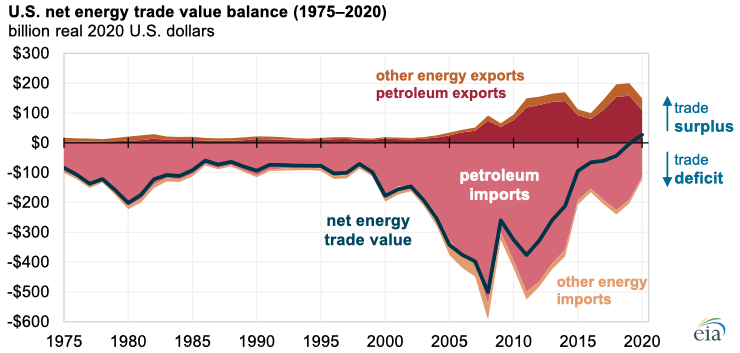
Natural gas accounts for an increasing share of the U.S. energy trade, and it accounted for 5% of energy import value and 22% of energy export value in 2020, resulting in a surplus of $26 billion. Volumes of U.S. natural gas exports reached a record high in 2020, and they have continued to increase in 2021. Through the first six months of 2021, the United States exported record volumes of pipeline gas to Mexico and liquefied natural gas (LNG).
Coal and electricity account for relatively small portions of the energy trade value. The United States has been a net exporter of coal volumes since at least 1949 and a net importer of electricity since 1969.
Principal contributor: Mickey Francis
Similar Stories
KBR selected by Power2X as project management consultant for its eFuels project in Rotterdam
KBR announced it has been awarded the Project Management Consultant (PMC) contract by Power2X for its eFuels project in Rotterdam.
View ArticleWhy Venezuela’s energy reforms are bringing investors back to the table in London
With Venezuela introducing sweeping reforms to its hydrocarbons sector and renewed international interest gathering pace, the Venezuela Energy Week London Industry Showcase will bring together policymakers, investors and industry leaders.
View ArticleCAMIMPEG confirmed as National Sponsor of Venezuela Energy Week 2026
CAMIMPEG has been confirmed as a National Sponsor of Venezuela Energy Week, taking place from October 26–29, 2026, in Caracas.
View ArticleHow the US-Iran scenarios shape Brent prices - Rystad Energy’s Oil Market Update
The oil market is shifting rapidly away from the simple question of whether the Strait of Hormuz reopens.
View Article
Port of Long Beach, MARAD sign first-of-its-kind partnership agreement on nuclear energy in maritime
View Article
DOT and Port of Long Beach sign agreement to test nuclear-powered vessels
View ArticleGet the most up-to-date trending news!
SubscribeIndustry updates and weekly newsletter direct to your inbox!
Follow us on social media:


