
What is OPEC+ and how is it different from OPEC?
May 11, 2023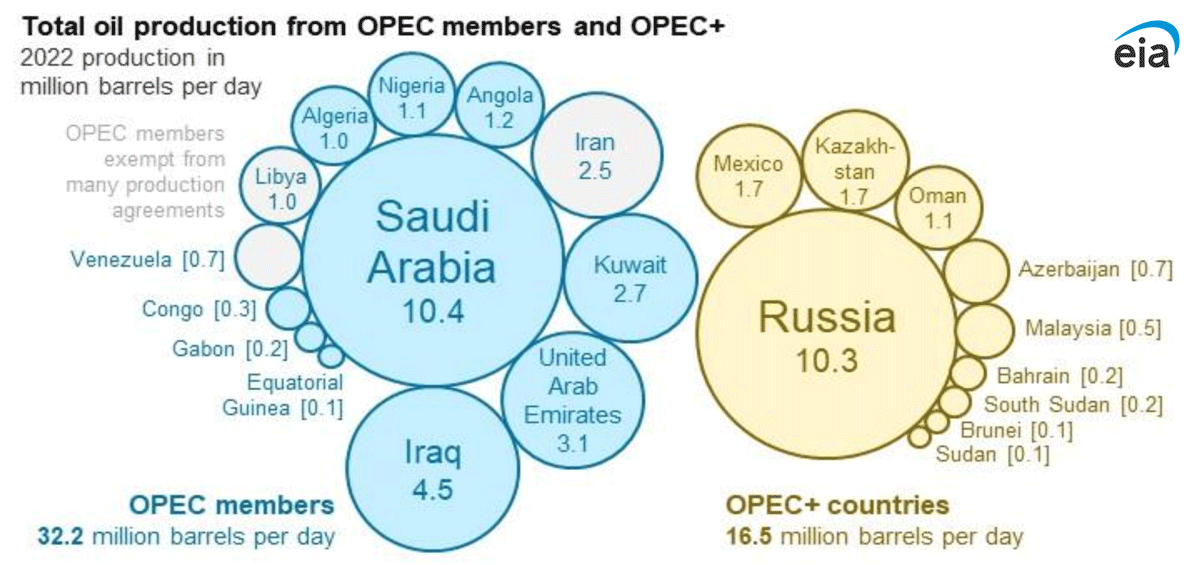
The Organization of the Petroleum Exporting Countries, also known as OPEC, was formed in 1960 by Iraq, Iran, Kuwait, Saudi Arabia, and Venezuela. The organization has since expanded to 13 members. OPEC regularly meets to set oil production targets and coordinate output to help manage global oil prices for the entire group.
In 2016, largely in response to dramatically falling oil prices driven by significant increases in U.S. shale oil output, OPEC signed an agreement with 10 other oil-producing countries to create what is now known as OPEC+. Among these 10 countries was the world’s third-largest oil producer in 2022, Russia, which produced 13% of the world's total (10.3 million barrels per day [b/d]).
OPEC’s stated objective is to “co-ordinate and unify petroleum policies among Member Countries” to secure pricing for producers, supply for consumers, and return on capital for investors, although the group is best known for its effect on global crude oil prices.
OPEC produced an estimated 32.2 million b/d of crude oil in 2022, which was 40% of total world oil production that year. The largest producer and most influential member of OPEC is Saudi Arabia, which was the world’s second-largest oil producer in 2022, after the United States.
Oil production in Russia remained above 10 million b/d in 2022 despite sanctions in response to its full-scale invasion of Ukraine. Russia’s oil output and effect on the market is significantly greater than that of other OPEC+ countries, such as Mexico and Kazakhstan, so the actions of the OPEC+ agreement are largely driven by coordination between OPEC and Russia.
OPEC meetings and coordinated production targets have always affected global oil prices, and market participants closely follow them. OPEC and OPEC+ countries combined produced about 60% of global oil production, 48 million b/d in 2022, and so influence global oil market balances and oil prices now more than ever. More recent production agreements have exempted Iran and Libya because of sanctions and other instability in crude oil output.
Over the past few years, OPEC+ meetings have focused on reducing oil production to help stabilize oil prices after the COVID-19 pandemic, which dramatically reduced demand and led to significantly lower oil prices. More recently, on April 2, 2023, OPEC+ members agreed to cut oil production by 1.2 million b/d until the end of 2023, which is in addition to production cuts already in place. This agreement means production targets will be 3.66 million b/d lower each month relative to actual August 2022 production through the end of 2023. Although these cuts are significant, we expect that growth in non-OPEC oil supply over the next two years will help balance markets and limit any significant increases in oil prices, according to our April Short-Term Energy Outlook
Similar Stories

Hybrid sales rise while battery electric sales remain lower after tax credit expiration
View ArticleKBR selected by Power2X as project management consultant for its eFuels project in Rotterdam
KBR announced it has been awarded the Project Management Consultant (PMC) contract by Power2X for its eFuels project in Rotterdam.
View ArticleWhy Venezuela’s energy reforms are bringing investors back to the table in London
With Venezuela introducing sweeping reforms to its hydrocarbons sector and renewed international interest gathering pace, the Venezuela Energy Week London Industry Showcase will bring together policymakers, investors and industry leaders.
View ArticleCAMIMPEG confirmed as National Sponsor of Venezuela Energy Week 2026
CAMIMPEG has been confirmed as a National Sponsor of Venezuela Energy Week, taking place from October 26–29, 2026, in Caracas.
View ArticleHow the US-Iran scenarios shape Brent prices - Rystad Energy’s Oil Market Update
The oil market is shifting rapidly away from the simple question of whether the Strait of Hormuz reopens.
View Article
Port of Long Beach, MARAD sign first-of-its-kind partnership agreement on nuclear energy in maritime
View ArticleGet the most up-to-date trending news!
SubscribeIndustry updates and weekly newsletter direct to your inbox!
Follow us on social media:


