
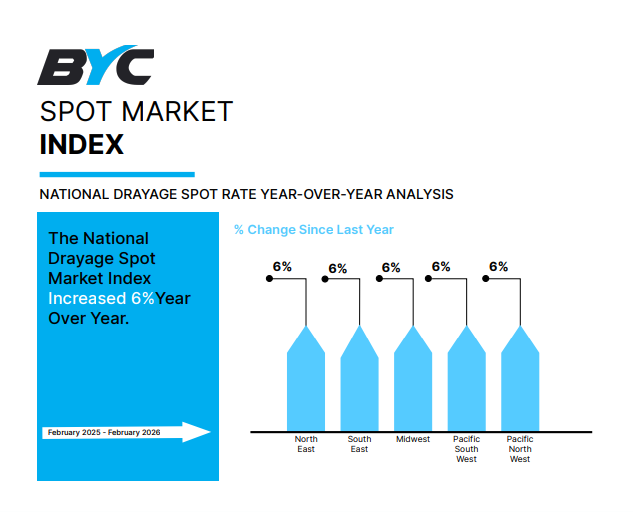
The National Drayage Spot Market Index has increased by 6% Year Over Year
Feb 06, 2026
February opens in a freight environment defined less by volatility and more by caution and recalibration. Industry leaders report that the broader freight market is starting the year at a measured pace, with shippers prioritizing reliability and supply chain stability over aggressively pursuing lower rates. This reflects a broader industry shift as companies move toward controlled inventory strategies and predictable cargo flows instead of reactive shipping patterns. For drayage, the result is a market that feels balanced: capacity is generally available, and rate movement is moderate. National drayage rates have increased 6% year-over-year. Physical network developments continue to shape how cargo moves across North America. The Port of Los Angeles is pressing forward with an extensive construction and modernization program aimed at improving terminal performance and long-term throughput. At the same time, the Port of Long Beach is planning a new terminal designed to capture high-velocity e-commerce volumes and is exploring development of a conventional zero-emissions terminal model. While these initiatives point to significant future efficiency gains, active construction and evolving gate patterns can create localized friction in the near term, including longer turn times and shifting appointment dynamics. Beyond the West Coast, Canada’s Port of Saint John is positioning itself to handle larger vessels and higher container volumes, strengthening its role as an alternative gateway and adding resilience to the broader North American network. On the policy and global trade front, renewed tensions affecting Red Sea shipping lanes continue to introduce uncertainty into ocean networks. Although this is not a direct drayage issue, vessel rerouting and schedule variability can lead to cargo bunching at discharge ports, which in turn compresses truck and terminal capacity when multiple vessels arrive within short windows. At the regulatory level, the Federal Maritime Commission is taking a closer look at ocean carrier limits on chassis choice. Any adjustment in this area could influence equipment availability at terminals and, over time, help ease chassis-related bottlenecks that contribute to split moves and delays. |
 |
Taken together, February’s market signal is one of stability supported by strategic groundwork. According to the U.S. Energy Information Administration, diesel now averages at $3.52 per gallon, down from $3.68 in February 2025 |
Similar Stories

Reimagining rail: Innovation on track with Intramotev
View Article
April 2026 Freight TSI rose 0.3% from March 2026 and rose 1.4% from April 2025
View ArticleGulftainer unveils 150-hectare regional powerhouse ‘Al Dhaid Multi-Modal Trade Corridor’
Gulftainer (GT) has unveiled its strategic plans to develop the Al Dhaid Multi-Modal Trade Corridor—a landmark 150-hectare regional powerhouse with annual capacity of 1.5 million TEUs.
View Article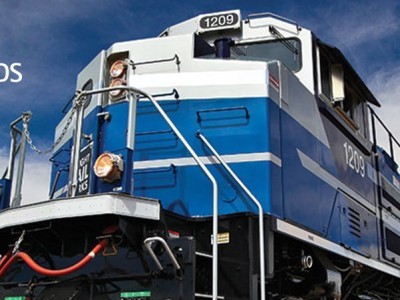
AAR reports rail traffic for the week ending June 06, 2026
View Article
CSX unveils commemorative locomotives marking America’s 250th anniversary
View Article
Freedom Intermodal expands advanced bulk liquid packaging facility in New Orleans
View ArticleGet the most up-to-date trending news!
SubscribeIndustry updates and weekly newsletter direct to your inbox!
Follow us on social media:


![[Freightos Weekly Update] Ocean rates climbing, with more increases expected soon](https://www.ajot.com/images/uploads/article/_thumbs/Support_grows_for_India%E2%80%99s_new_maritime_CCTV_rules.jpg)


![[Freightos Weekly Update] Container rates starting to spike on peak season rush](https://www.ajot.com/images/uploads/article/_thumbs/LB_stacked_containers.JPG)