
Rystad Energy Report: Oil and gas spending rockets on security concerns
May 11, 2023
Global energy reliability concerns are triggering a surge in oil and gas investments – but this uptick is only temporary, and service companies should capitalize now before the focus returns to the energy transition. After Russia invaded Ukraine, expected investments in fossil fuels in 2022 and 2023 surged by $140 billion, Rystad Energy research shows. Before the war, the two-year total was projected at $945 billion, but as the war sparked shortages and sky-high prices, expected spending has jumped to almost $1.1 trillion.
Of the $140 billion growth, shale production attracted most of the limelight with an additional $80 billion increase, as activity climbed 30% and pricing for oilfield services jumped nearly 50%. Offshore production accounted for $40 billion in growth, while other onshore activities expanded by an additional $20 billion.
"Service companies should make the most of this upturn now while keeping one eye firmly on the future. The energy transition is not slowing down; huge waves of investments in renewables and clean tech are on the horizon. So, to ensure their long-term success, service companies should adapt their offerings now to capitalize fully on the inevitable green revolution."
Audun Martinsen, head of supply chain research, Rystad Energy
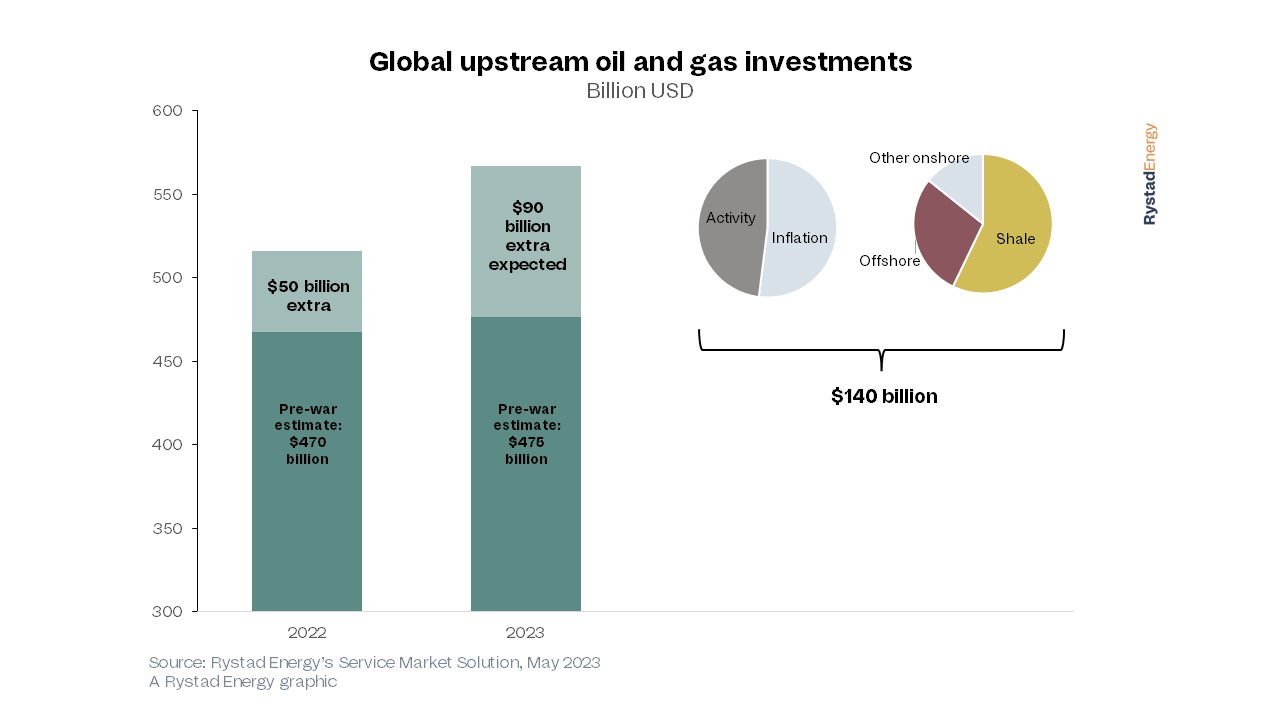
Last year’s sudden need for more upstream activity through more rigs, more completed wells, and more greenfield sanctioning was so strong that the oilfield service supply chain could not meet the record demand for services and equipment that emerged in shale, offshore and conventional markets. As a result, service prices rose, and more than half of the additional spending so far has ended up as a five percentage-point increase in suppliers’ profit margins rather than as more activity.
Energy security concerns have unlocked significant additional investments in oil and gas, boosting spending forecasts and sending the expected timing for peak oil demand out in time. The first wave of extra spending over the past 15 months mainly went to oil and gas, while low-carbon industries faced a slowdown due to high inflation and shortages in the supply chain. But low-carbon spending will bounce back, as energy security is not only about securing oil and gas here and now but also about securing cleaner energy for the future.
The US Inflation Reduction Act and the recently announced Critical Raw Mineral and Technology Acts in the European Union will strengthen the significant investment cycle brewing in the renewable and clean-tech sectors. Solar, wind, carbon capture, hydrogen, and batteries are all markets that will benefit from supportive policies to accelerate low-carbon deployment and build up local supply chains.
“Gaining control of the supply chain is crucial for countries and regions to become less dependent on global value chains. Even though the sun shines and the wind blows in every country, the energy must still be harnessed and stored locally. This can only be done with a reliable, often local, supply chain,” says Martinsen.

Similar Stories

Hybrid sales rise while battery electric sales remain lower after tax credit expiration
View ArticleKBR selected by Power2X as project management consultant for its eFuels project in Rotterdam
KBR announced it has been awarded the Project Management Consultant (PMC) contract by Power2X for its eFuels project in Rotterdam.
View ArticleWhy Venezuela’s energy reforms are bringing investors back to the table in London
With Venezuela introducing sweeping reforms to its hydrocarbons sector and renewed international interest gathering pace, the Venezuela Energy Week London Industry Showcase will bring together policymakers, investors and industry leaders.
View ArticleCAMIMPEG confirmed as National Sponsor of Venezuela Energy Week 2026
CAMIMPEG has been confirmed as a National Sponsor of Venezuela Energy Week, taking place from October 26–29, 2026, in Caracas.
View ArticleHow the US-Iran scenarios shape Brent prices - Rystad Energy’s Oil Market Update
The oil market is shifting rapidly away from the simple question of whether the Strait of Hormuz reopens.
View Article
Port of Long Beach, MARAD sign first-of-its-kind partnership agreement on nuclear energy in maritime
View ArticleGet the most up-to-date trending news!
SubscribeIndustry updates and weekly newsletter direct to your inbox!
Follow us on social media:


