
Nickel market eyes fate of Siberian metal as sanctions bite

by Bloomberg Mar 03, 2022
The biggest risk in battery materials from Russia’s increasing economic isolation centers on supplies of top-notch Arctic nickel controlled by the country’s richest man.
Russia is a major producer of the metal that will be needed in huge quantities as the world’s auto fleet goes battery-powered. That means the electric-vehicle industry has much at stake as global businesses rejig ties in the wake of the invasion of Ukraine. Mining giant BHP Group on Monday warned of nickel supply shocks.
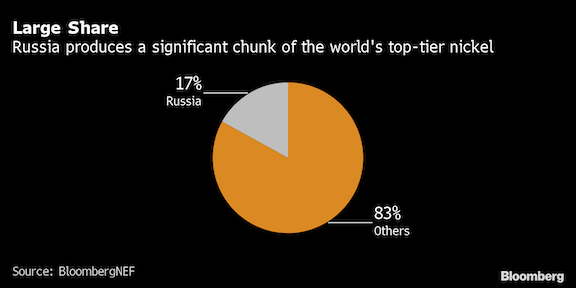
The key lies with giant mines in far northern Siberia that were first dug in Stalin’s time and which are now run by MMC Norilsk Nickel PJSC. Norilsk makes 17% of the world’s so-called “Class 1” nickel, a high-purity form that’s more suitable for batteries and can be sourced in large quantities from only a few other locations. The company is controlled by multi-billionaire Vladimir Potanin.
“I certainly think the invasion will have a knock-on effect of further tightening Class 1 availability,” Greg Miller, analyst at Benchmark Mineral Intelligence said by email. “Many customers—particularly in Europe and North America—will either be unable or very reluctant to accept Russian nickel, driving competition for alternative sources.”
Nickel jumped to a fresh 11-year high on Wednesday above $26,000 a ton on the London Metal Exchange. There’s the risk that more expensive nickel will ratchet up pressure on battery and car-makers already grappling with soaring costs—especially for lithium.
While Norilsk primarily supplies nickel to the steel and alloys sectors, any reduction in its shipments would have a knock-on effect across all nickel markets at a time of very low inventories.
So far, Norilsk Nickel’s shipments have not been significantly disrupted, a person familiar with the matter said on Wednesday. Some shipholders have declined to transport its nickel and a shortage of containers is a concern, but the effect is not material and buyers are still taking the metal, the person said.
Russia doesn’t have a big heft in other key battery materials. It produces some cobalt as a by-product of nickel, and its presence in lithium, graphite and manganese is negligible to small.
Bloomberg
© Bloomberg
The author’s opinion are not necessarily the opinions of the American Journal of Transportation (AJOT).
Similar Stories

Key European shipping corridor hit by river and rail freight ‘double whammy’
View Article
DHL Group deploys Disaster Response Team to Venezuela
View Article
Asian nations are building new trading zones to deflect the Trump tariff impact
View Article
Tighter supply and higher prices reshape Pacific Rim softwood markets
View Article
WCAworld launches emergency appeal to support earthquake relief efforts in Venezuela
View Article
U.S. international trade in goods and services, May 2026
View ArticleGet the most up-to-date trending news!
SubscribeIndustry updates and weekly newsletter direct to your inbox!
Follow us on social media:


