
Electricity production costs rose with fuel costs in 2021, delivery cost remained elevated
Feb 27, 2023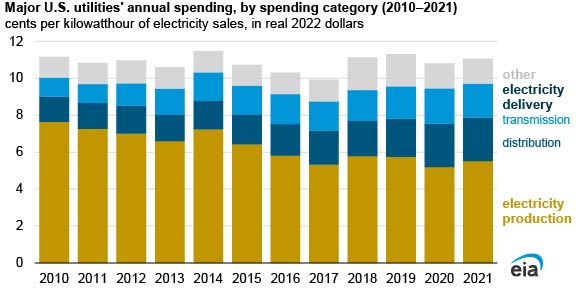
After adjusting for inflation, costs for major U.S. utilities to produce electricity rose 6% in 2021 as a result of rising fuel costs. For a number of years, electricity production costs had declined as natural gas prices fell and new low-cost renewable generators came online. The cost to deliver electricity across transmission and distribution lines increased 12% in 2020 and remained steady in 2021.
The cost to produce electricity includes the money spent to build, operate, fuel, and maintain power plants and to purchase electricity from markets and other generators. Production costs fluctuate, depending on the prices of fuel, capital, labor, and building materials and the type of power plants being built.
Utility spending on purchased electricity, which is the largest production cost component, rose 17% to $66.0 billion in 2021. A utility purchases electricity when it does not own the generators or does not generate enough electricity to fulfill customer demand. In addition, the costs for natural gas, capital, labor, and building materials also rose.
Spending on new power plants, the second-largest production cost component, fell 21% from $27.4 billion in 2020 to about $21.7 billion in 2021. Spending on renewables—mostly wind and solar generators—accounted for the bulk (65%) of investment in 2021. New natural gas-fired generators accounted for 22% of investment spending, followed by nuclear at 9% and hydropower at 4%.
Utility spending on electricity delivery includes the money spent to build, operate, and maintain the wires, poles, towers, and meters that make up the country’s transmission and distribution systems. Over the past 30 years, utilities have been increasing their spending (in real dollar terms) to maintain and update the aging U.S. power delivery system. These costs include:
• Replacing aging equipment
• Building new transmission infrastructure for growing wind and solar generation
• Implementing new technologies to increase grid operational efficiency, reliability, resilience, and security.
Since the mid-1990s, major utilities’ annual spending on the high voltage transmission system has increased by almost 500%, and annual spending on the lower voltage neighborhood distribution system has more than doubled. In 2021, spending on electricity infrastructure remained high, although spending increases slowed—up 1% on the distribution system and down 3% on the transmission system.
Utilities’ other costs include general and administrative expenses, general infrastructure such as office space, and spending on intangible goods such as licenses and franchise fees.
Similar Stories

EIA gasoline prices July 14,2026
View Article
PowerCell secures multi-MW Power Generation order for AI data center
View Article
Fuel price shocks ripple through freight markets
View Article
How offshore industries can reduce water pollution risks
View Article
The United States produced more crude oil than any other country in 2025
View Article
Shell to sell Sprng Energy group to Aditya Birla Renewables Limited
View ArticleGet the most up-to-date trending news!
SubscribeIndustry updates and weekly newsletter direct to your inbox!
Follow us on social media:


