
Electric load in southern MISO fell as Hurricane Ida moved through Louisiana
Sep 14, 2021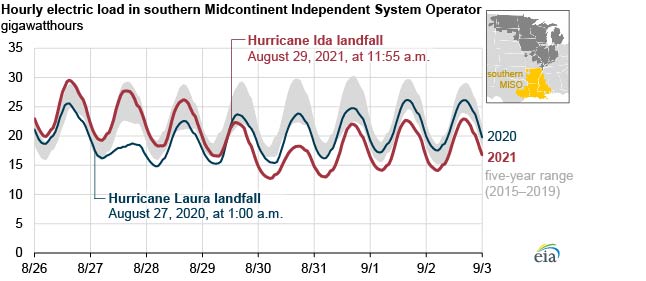
As Category 4 Hurricane Ida made landfall along the Southeast coast of Louisiana near New Orleans on August 29, 2021, the electric load in the southern region of the Midcontinent Independent System Operator (MISO) decreased. Hourly electric loads on August 30, the day after landfall, were about 25% to 30% lower than the average for that day of the year over the past six years. Southern MISO experienced a similar decline in electric load last year when Hurricane Laura made landfall.
The southern region of MISO consists of electricity service areas in Arkansas, Louisiana, western Mississippi, and eastern Texas. This region typically accounts for about one-quarter of electric load in MISO.
Damage to transmission and distribution lines caused by Hurricane Ida resulted in power outages for approximately 1.2 million customers in Louisiana and Mississippi. Entergy, one of the major power providers in the region, reported 210 transmission lines were out of service, including all eight transmission lines that deliver power into New Orleans. These transmission outages affected more than 2,000 miles of Entergy’s total 16,100 miles of transmission lines. The hurricane also damaged 220 of Entergy’s 1,300 substations. These substations convert high-voltage electricity carried over transmission lines to the lower voltage levels used for local distribution—a critical role.
Because of the electric load decrease caused by Hurricane Ida, electric generation in the southern MISO region was forced to drop by a corresponding amount to keep the grid in balance. Hourly nuclear generation decreased significantly, falling from 5.2 gigawatts (GW) on August 29 to 3.7 GW on August 30. The River Bend Station nuclear plant was cut back to 40% of its capacity. In addition, the Waterford 3 nuclear plant located 25 miles west of New Orleans was shut down as a safety precaution because of high winds on the morning of August 29.
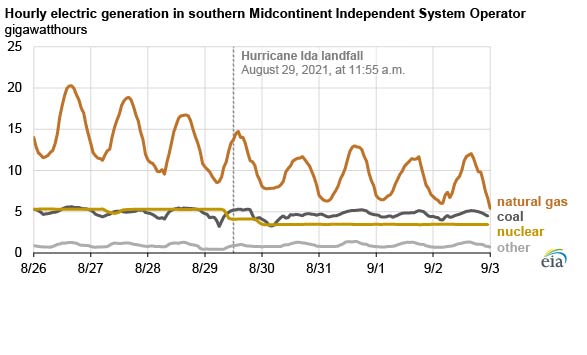
Natural gas-fired power plants also reduced electric generation. Hourly natural gas-fired electric generation in the southern MISO region peaked at 20 gigawatts (GW) on August 26, but it only reached 12 GW on August 30.
Similar Stories
CAMIMPEG confirmed as National Sponsor of Venezuela Energy Week 2026
CAMIMPEG has been confirmed as a National Sponsor of Venezuela Energy Week, taking place from October 26–29, 2026, in Caracas.
View ArticleHow the US-Iran scenarios shape Brent prices - Rystad Energy’s Oil Market Update
The oil market is shifting rapidly away from the simple question of whether the Strait of Hormuz reopens.
View Article
Port of Long Beach, MARAD sign first-of-its-kind partnership agreement on nuclear energy in maritime
View Article
DOT and Port of Long Beach sign agreement to test nuclear-powered vessels
View ArticleSPIRO publishes its first Sustainability Report
SPIRO published its inaugural Sustainability Report.
View Article
Latest Bureau Veritas approvals strengthen confidence in Anemoi Rotor Sail technology
View ArticleGet the most up-to-date trending news!
SubscribeIndustry updates and weekly newsletter direct to your inbox!
Follow us on social media:


