EIA expects US hydropower generation to decline 14% in 2021 amid drought
Sep 23, 2021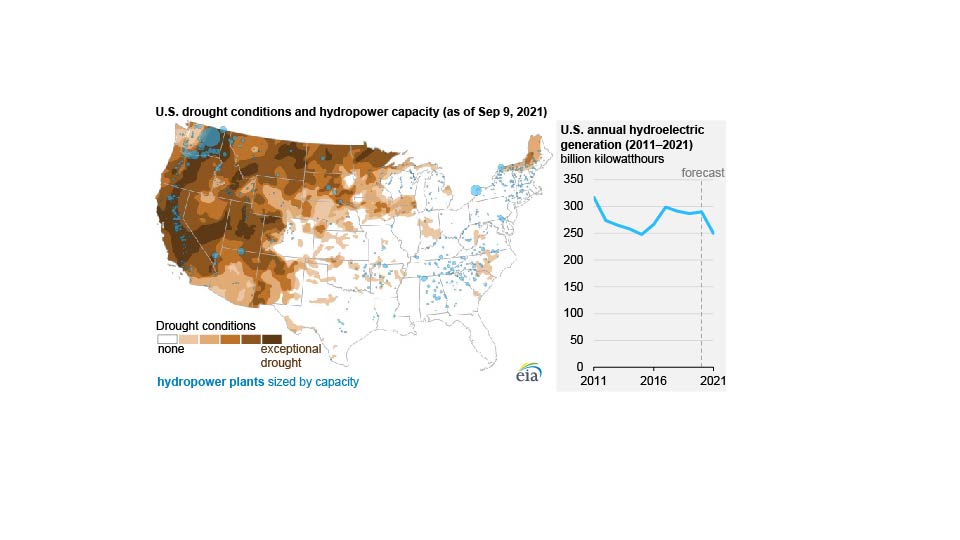
In our latest Short-Term Energy Outlook (STEO), we forecast that electricity generation from U.S. hydropower plants will be 14% lower in 2021 than it was in 2020. Extreme and exceptional drought conditions have been affecting much of the western United States, especially California and states in the Pacific Northwest, which are home to the majority of U.S. hydropower capacity.
The Pacific Northwest’s Columbia River is the fourth-largest river in the United States by volume. Its watershed, the Columbia River Basin, covers large parts of four states: Washington, Oregon, Idaho, and Montana. In 2020, hydropower plants in these states generated 136 billion kilowatthours (kWh) of electricity, representing 54% of U.S. hydropower generation that year.
After dry conditions and a record-breaking heat wave affected large parts of the Columbia River Basin this summer, drought emergencies were declared in counties across Washington, Oregon, and Idaho.
The dry conditions have reduced reservoir storage levels in some Columbia River Basin states. According to the U.S. Department of Agriculture’s National Water and Climate Center (NWCC), reservoir storage in Montana and Washington is at or above average. However, as of the end of August 2021, reservoir storage in Oregon measured 17% of capacity, less than half its historical average capacity of 47%. Idaho reported reservoir storage at 34% of capacity, lower than its historical average capacity of 51%.
In March and April of 2021, hydropower generation in both Washington and Oregon was 10% below the 10-year (2011–20) range. Over the summer, hydropower generation in these states moved back within the 10-year range.
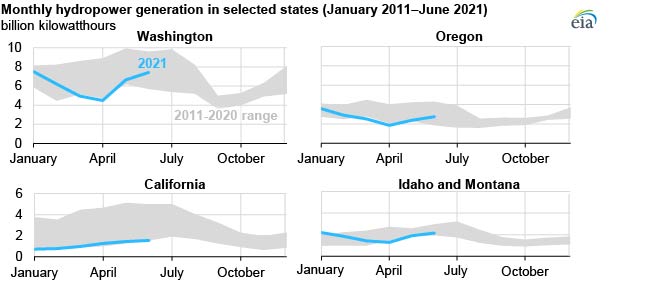
California contains 13% of the United States’ hydropower capacity; in 2020, hydropower plants in California produced 7% of the country’s hydropower generation. However, the state is experiencing intense and widespread drought this year, which has reduced water supply and hydropower generation. The reservoir at Lake Oroville, the second-largest reservoir in California, hit a historic low of 35% in August 2021, prompting the Edward Hyatt Power Plant to go offline for the first time since 1967. So far this year, hydropower generation in California has been on the lower end of its 10-year range.
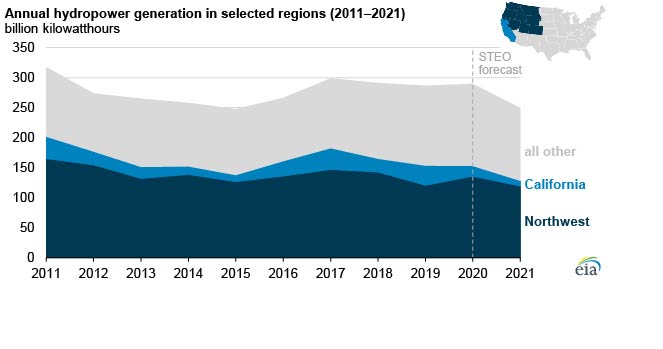
In STEO, we forecast electricity generation for electricity market regions instead of state geographical boundaries. The latest STEO expects hydropower generation in the Northwest electricity region, which includes the Columbia River Basin and parts of other Rocky Mountain states, to total 120 billion kWh in 2021, a 12% decline from 2020. We expect hydropower generation in the California electricity region to be 49% lower in 2021 than in 2020, at 8.5 billion kWh.
Similar Stories

Hybrid sales rise while battery electric sales remain lower after tax credit expiration
View ArticleKBR selected by Power2X as project management consultant for its eFuels project in Rotterdam
KBR announced it has been awarded the Project Management Consultant (PMC) contract by Power2X for its eFuels project in Rotterdam.
View ArticleWhy Venezuela’s energy reforms are bringing investors back to the table in London
With Venezuela introducing sweeping reforms to its hydrocarbons sector and renewed international interest gathering pace, the Venezuela Energy Week London Industry Showcase will bring together policymakers, investors and industry leaders.
View ArticleCAMIMPEG confirmed as National Sponsor of Venezuela Energy Week 2026
CAMIMPEG has been confirmed as a National Sponsor of Venezuela Energy Week, taking place from October 26–29, 2026, in Caracas.
View ArticleHow the US-Iran scenarios shape Brent prices - Rystad Energy’s Oil Market Update
The oil market is shifting rapidly away from the simple question of whether the Strait of Hormuz reopens.
View Article
Port of Long Beach, MARAD sign first-of-its-kind partnership agreement on nuclear energy in maritime
View ArticleGet the most up-to-date trending news!
SubscribeIndustry updates and weekly newsletter direct to your inbox!
Follow us on social media: