
EIA expects US electricity generation from renewables to soon surpass nuclear and coal
Jan 30, 2020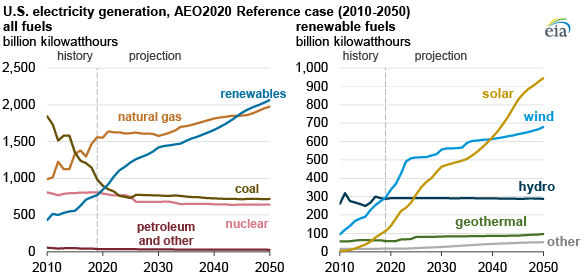
In the latest long-term projections, the U.S Energy Information Administration (EIA) projects electricity generation from renewable sources such as wind and solar to surpass nuclear and coal by 2021 and to surpass natural gas in 2045. In the Annual Energy Outlook 2020 (AEO2020) Reference case, the share of renewables in the U.S. electricity generation mix increases from 19% in 2019 to 38% in 2050.
Most of the growth in renewable electricity generation is attributed to wind and solar, which account for about half of renewable generation today. In EIA’s AEO2020 Reference case, these technologies account for nearly 80% of the renewable total in 2050. New wind capacity additions continue at much lower levels after production tax credits expire in the early 2020s.
In AEO2020, growth in solar photovoltaic (PV) capacity continues through 2050 for both utility-scale and small-scale applications because of declining PV costs throughout the projection period. Conventional hydroelectric generation remains relatively unchanged in absolute terms and becomes a smaller portion of the generation mix as other sources of electricity generation increase.
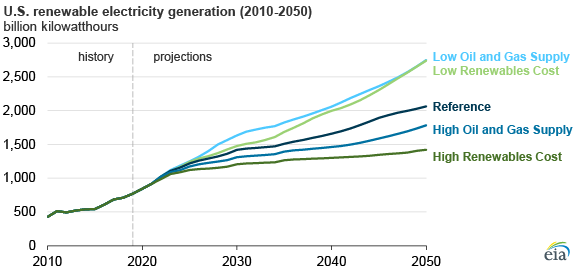
Alternative scenarios in AEO2020 examine the sensitivity of results to changes in the costs of renewables and the availability of oil and natural gas resources. Even in the High Oil and Gas Supply (where natural gas prices remain lower than in the Reference case) and High Renewables Cost cases, renewable generation nearly doubles from current levels by 2050.
The High and Low Renewables Cost cases evaluate the effects of changing cost assumptions for constructing and operating renewable energy power plants. In all AEO2020 scenarios, experience-based factors (such as learning-by-doing) contribute to lower capital costs over time.
For the Low Renewables Cost case, EIA assumed learning rates for renewable technologies that result in overnight capital costs that, by 2050, are 40% lower than the Reference case assumptions for each renewable technology (including those in the end-use sectors, such as small-scale solar PV). For the High Renewables Cost case, EIA assumed the overnight capital cost for all renewable technologies are held constant at the 2019 level through 2050.

Renewable generation grows in all regions of the United States in all AEO2020 scenarios, but the preferred technology type depends on the availability of renewable energy resources. Wind-powered generation grows the most in the West and Mid-Continent regions, and solar-powered generation grows the most in the Southeast. Offshore wind is only built off the coast of the Northeast and the PJM Interconnection.

Similar Stories

Today in energy: China’s nuclear power capacity nearly doubled since 2016
View Article
Global biofuel demand set to grow by nearly 70% as food prices rise
View Article
MOL to invest in the first offshore LNG liquefaction facility in the US
View Article
BHP and GCMD trial multi-feedstock B100 blend in an existing supply chain
View Article
U.S. natural gas storage capacity increased slightly in 2025
View Article
Echandia launches new battery system that lowers upfront cost and footprint by 30 percent
View ArticleGet the most up-to-date trending news!
SubscribeIndustry updates and weekly newsletter direct to your inbox!
Follow us on social media:


![[Freightos Weekly Update] Container rates starting to spike on peak season rush](https://www.ajot.com/images/uploads/article/_thumbs/LB_stacked_containers.JPG)