
Auto supply chains face delays on Baltimore bridge collapse

by Bloomberg Mar 26, 2024
The US automotive supply chain will be disrupted by the collapse of the Francis Scott Key Bridge in Baltimore, dealing another blow to America’s automotive ecosystem still recovering from pandemic-related setbacks.
“It’s a large port with a lot of flow through it, so it’s going to have an impact,” John Lawler, Ford Motor Co.’s chief financial officer, said Tuesday on Bloomberg TV. “We’ll work on the workarounds. We’ll have to divert parts to other ports along the East Coast or elsewhere in the country.”
General Motors Co. also said it is working to reroute vehicle shipments that had come through the Port of Baltimore, which is now closed as authorities conduct a search and rescue for those who fell from the bridge. GM said in a statement that it expected “minimal impact” from the port closing.
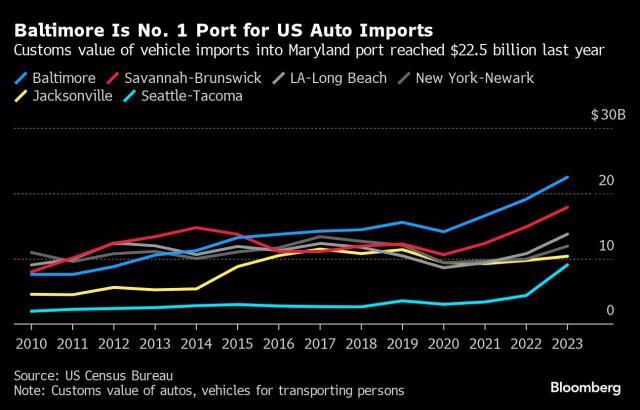
The disruption comes as automotive inventories are just returning to normal following prolonged shortages of semiconductors and other essential automotive parts during the Covid-19 pandemic. The supply crisis exposed vulnerabilities in the US auto industry, which has relied on a “just-in-time” supply chain that can be broken by the interruption of production or distribution of just a few parts.
“We have experience now in understanding supply chain disruptions,” Lawler told Bloomberg TV. “So we’ll just put that experience to work and figure out the best solution.”
Baltimore for years has been the top US vehicle-handling port, with more than 847,000 cars and light trucks processed through there last year. European carmakers including BMW, Volkswagen and Mercedes-Benz, have set up facilities in and around the port to handle vehicle shipments.
Data compiled by Bloomberg shows that so far this month, Mazda had the most imports into the US though Baltimore by dollar value, followed by Mercedes-Benz, Subaru, Mitsubishi and VW.
VW said Tuesday its port operations aren’t affected by the collapse because its terminal is located along the seaboard just outside of the bridge, as opposed to inland. Last year, VW received, processed and shipped about 100,000 vehicles through Baltimore for dealers in the Northeast and Mid-Atlantic regions of the US. VW said there may be trucking delays as a result of the accident.
A BMW spokesman said the automaker didn’t expect the bridge collapse to have “any immediate impact on our business, other than short term traffic delays.”
Mercedes-Benz, which also has a vehicle processing facility in Baltimore, didn’t immediately respond to a request for comment.
Bloomberg
© Bloomberg
The author’s opinion are not necessarily the opinions of the American Journal of Transportation (AJOT).
Similar Stories
Port of Antwerp-Bruges stands firm in challenging first half of 2026
Cargo handling declined by 2.4%, the container market share remained stable, and investments continued to support future growth.
View Article
Port of Los Angeles records best June ever, tops 1 million container units
View Article
Two new gas carriers select Wärtsilä 25 Ammonia engine to support environmental compliance
View Article
SMM 2026 launches dedicated Naval Hall
View Article
Port of Los Angeles’ Seroka report 1 million TEUs in June up 12%
View Article
Relief as Trump backs down on Hormuz toll, but fear of escalation in Gulf conflict re-ignited
View ArticleGet the most up-to-date trending news!
SubscribeIndustry updates and weekly newsletter direct to your inbox!
Follow us on social media:


