
Airlines begin to cut flying as they grapple with fuel costs

by Bloomberg Mar 10, 2022
U.S. airlines have begun paring flight plans due to soaring fuel prices, underscoring the speed at which Russia’s attack on Ukraine has upended the industry and jeopardized a hoped-for rebound this year.
Alaska Air Group Inc. will trim flying by as much as 5% in the first half in response to “the sharp rise in fuel costs,” according to a regulatory filing Tuesday.
Allegiant Airlines plans to reduce second-quarter capacity between 5% and 10%, Chief Financial Officer Greg Anderson said at a Raymond James Financial Inc. conference Monday. The carrier will trim flight frequency mainly in weaker demand times. The comments, relayed in a note by Raymond James analyst Savanthi Syth, were confirmed by an Allegiant spokeswoman.
The industry concern is that exorbitant gasoline prices could sap consumers’ spending power and lead to slower demand for vacations and other leisure pursuits. Higher prices also raise costs for airlines, making it difficult to maintain profits if they can’t pass the expenses along to customers.
European carriers face similar challenges. Wizz Air Holdings Plc this week cut back on its expansion plans for summer and reversed a no-hedging policy to limit its exposure to higher fuel prices. Other major players in Europe, including Ryanair Holdings Plc, Deutsche Lufthansa AG and Air France-KLM, are at least partially hedged.
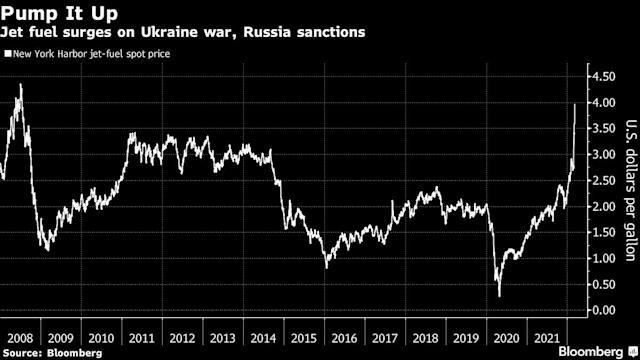
Spot jet fuel prices for delivery in New York harbor have jumped 76% this year to $4.06 a gallon, the highest since 2008. In January U.S. airlines were predicting they’d pay around $2.50 a gallon.
Alaska shares rose 6.8% on Tuesday in New York, rebounding after the airline industry plunged Monday. Allegiant’s parent, Allegiant Travel Co., advanced 2.6%.
Seattle-based Alaska sees continued strong demand for spring break and summer travel, but it cited fuel prices as a significant uncertainty. “The impact on the economy is the question we all have now,” CFO Shane Tackett said at a Raymond James conference.
Alaska still expects to return to its full pre-pandemic levels of capacity this summer but “will continue to prudently adjust capacity as necessary in response to the evolving fuel environment,” the company said in the filing.
Bloomberg
© Bloomberg
The author’s opinion are not necessarily the opinions of the American Journal of Transportation (AJOT).
Similar Stories

The United States produced more crude oil than any other country in 2025
View Article
Maiden call of the CMA CGM Notre Dame in Rotterdam
View Article
Chapman Freeborn helps restore Air Zimbabwe’s Harare–London Gatwick route
View ArticleDepartment of Transportation moves forward on Delfin LNG deepwater port licensing following court win
The U.S. Department of Transportation’s Maritime Administration (MARAD) will move forward with issuing a Deepwater port license to Delfin LNG following a decision by the U.S. Court of Appeals for…
View Article
Airfowarders Association regrets resumption of hostilities between United States and Iran
View Article
FlyUs expands Riyadh Cargo partnership
View ArticleGet the most up-to-date trending news!
SubscribeIndustry updates and weekly newsletter direct to your inbox!
Follow us on social media:


