
95% of the fuel ethanol moved in the US in the first half of 2022 moved by rail
Oct 18, 2022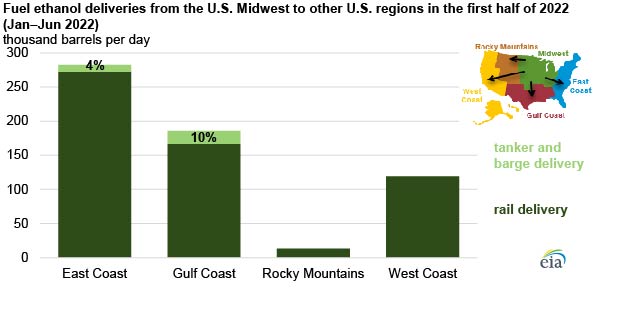
Fuel ethanol, a biofuel most commonly mixed with finished motor gasoline, is second only to coal as the most-transported fuel by rail. According to our Petroleum Supply Monthly, 95% of all U.S. fuel ethanol deliveries between regions in the first half of 2022 were by rail. The majority of the U.S. capacity to produce fuel ethanol (94%) is in the Midwest; however, most fuel ethanol is consumed in other regions.
In the first half of 2022, nearly all of the fuel ethanol that was delivered by rail (97%) originated in the Midwest. Rail accounted for 96% of the Midwest’s fuel ethanol deliveries to the East Coast and 90% of deliveries to the Gulf Coast. All fuel ethanol deliveries to the Rocky Mountain and West Coast regions were transported from the Midwest by rail. These percentages have held relatively steady since 2010, the earliest data on record.
Primary energy commodities—coal, petroleum liquids, and natural gas—can be transported by pipeline, barge, rail, or truck. Fuel ethanol can corrode steel pipelines, so it is primarily transported by rail, barge, or truck.
Fuel ethanol delivery by barge and tanker is limited to pickup and delivery locations along coastal and navigable inland waterways. The Jones Act requires that all goods transported between two U.S. ports must be transported by U.S.-flagged ships, built domestically, and owned and crewed by U.S. citizens. Transport by truck is generally limited to distances of a few hundred miles and is used primarily as the final mode of transport. For these reasons, rail has historically accounted for nearly all of the fuel ethanol movements across regions.
Fuel ethanol arrives at blending terminals by railcar, and gasoline arrives by pipeline. Once in the terminal, the two fuels are blended into finished motor gasoline, which is transported to retail gasoline stations in tanker trucks.
Nearly all of the motor gasoline now sold in the United States is about 10% fuel ethanol by volume (E10). Fuel ethanol helps finished motor gasoline meet requirements for the Renewable Fuel Standard (RFS) under the Energy Policy Act of 2005, which sets annual targets for the quantity of renewable fuels required to enter into the U.S. fuel supply, and for oxygenated and reformulated gasoline.
Similar Stories

The United States produced more crude oil than any other country in 2025
View ArticleShell to sell Sprng Energy group to Aditya Birla Renewables Limited
Shell Overseas Investment B.V. signed an agreement with Aditya Birla Renewables Limited (ABRen) to sell 100% of Solenergi Power Private Limited, which includes the Sprng Energy group of companies, for…
View ArticleFranc Mouzabakani takes the helm of the Republic of Congo’s upstream petroleum sector
Franc Mouzabakani Kiesse has been appointed Director General for of the Upstream Petroleum Sector for the Republic of Congo.
View Article
Port of Long Beach honored for Intermodal Innovation
View Article
US intermodal freight holds firm in July, IANA Index shows
View Article
Maiden call of the CMA CGM Notre Dame in Rotterdam
View ArticleGet the most up-to-date trending news!
SubscribeIndustry updates and weekly newsletter direct to your inbox!
Follow us on social media:


